
This post is also available in:
 Português
  Español
  Français
  Deutsch
  Italiano
  Русский
Iran missiles Israel: war hits day 100 with a new escalation
UPDATED: Netanyahu Strikes Iran Anyway
June 7, 2026, is day 100 of the Iran-Israel-US war. And Iran just reminded the world it is not finished.
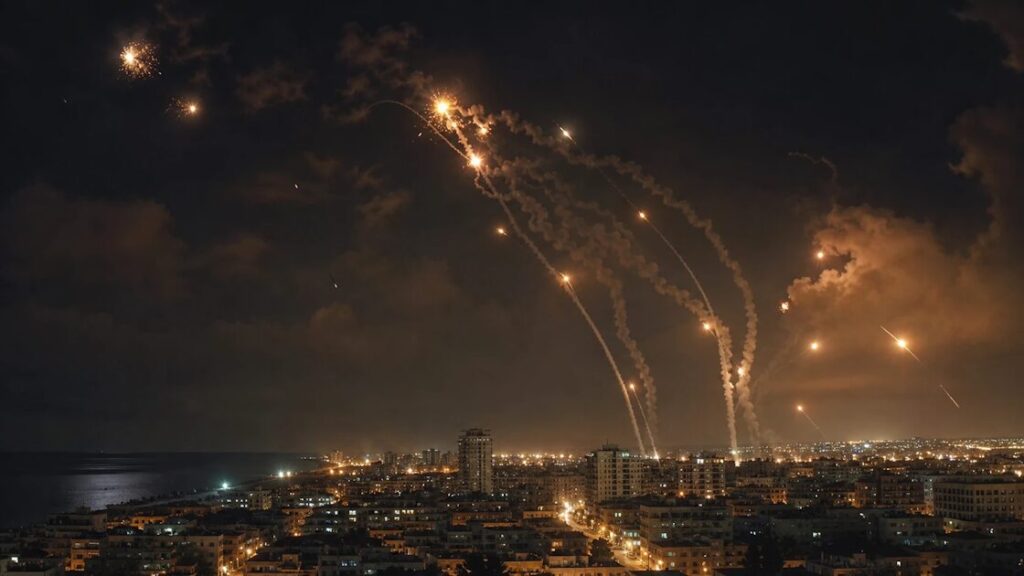
On June 7, 2026, Iran fired approximately 10 ballistic missiles at northern Israel in multiple salvos.
Air raid sirens screamed across northern Israel, including the city of Haifa.
Hospitals moved underground. Schools were cancelled across the country. Bus services were cut to 75% of normal capacity.
The Israeli military activated its air defense systems and intercepted every missile. So far, no direct impacts, injuries, or damage have been reported.
But the message from Tehran was unmistakable — the ceasefire that held since April is now under severe pressure.
This is the first time Iran has fired directly at Israel since early April.
The war just escalated again. And the diplomatic track that Trump has been carefully building is now hanging by a thread.
How we got here — the sequence of events that led to June 7, 2026
This escalation did not come out of nowhere. Here is exactly what happened, step by step:
Hezbollah fired missiles into northern Israel first.
Israel struck Hezbollah targets in the southern suburbs of Beirut in direct retaliation.
Iran then fired approximately 10 ballistic missiles at northern Israel in response to the Beirut strikes.
The Israeli military intercepted all incoming missiles. So far no casualties or damage confirmed.
Trump called Netanyahu immediately and urged him NOT to retaliate against Iran.
Netanyahu agreed to delay a response, but an Israeli official vowed it will come “even if not immediate.” An Iranian official told a US news outlet that a deal with Trump “is no longer feasible at this stage.”
One fact deserves emphasis here. Hezbollah fired FIRST. Israel responded to Hezbollah — not to Iran.
Iran then chose to escalate by firing directly at Israeli territory. The chain of aggression in the events of June 7, 2026, began with Hezbollah, not with Israel.
That context matters when evaluating what comes next.
What Trump said — and why his position deserves respect
Trump’s response was swift and direct from two directions at once.
To Iran, he said: “What I would suggest to Iran: You’ve shot your missiles, that’s enough. Get back to the table and make a deal.”
To Israel, he urged restraint — telling Axios “We don’t need another one” when asked about an Israeli counter-strike.
On the surface, asking Israel not to retaliate after absorbing Iranian missiles seems unfair. Hezbollah started this chain. Israel responded proportionally. Iran escalated.
Why should Israel stand down?
The honest answer is that Trump has information none of us have. He knows the current state of US missile stockpiles after Operation Epic Fury.
He knows how close — or how far — the Iran negotiation track actually is.
He knows what a full Israeli counter-strike on Iranian territory could trigger across the region.
Calling for restraint while simultaneously telling Iran to “get back to the table” is not weakness. It is a man managing multiple simultaneous crises with maximum pressure and finite resources.
Both Netanyahu and Trump are strong leaders. Even the best allies disagree. What matters is the outcome.
Where the war stands — and what Iran’s words reveal
More context matters, and the last 3-4 days have seen this conflict accelerate rapidly.
On June 2, US forces struck Iran’s Qeshm Island in self-defense after Iran shot down a US drone.
Iran retaliated with missiles against US bases in Kuwait and Bahrain — all of which failed to hit their targets.
Trump and Netanyahu had their now-famous heated phone call over Israel’s Lebanon escalation.
Netanyahu pulled back from Beirut strikes temporarily. Trump posted that Iran talks were “continuing at a rapid pace.”
Then, on June 7, 2026 — Iran fires on Israel anyway.
The Iranian official’s statement that a deal with Trump “is no longer feasible at this stage” deserves careful reading. It could be a negotiating tactic designed to extract better terms.
Or it could also be a genuine signal that Iran’s new Supreme Leader Mojtaba Khamenei, son of the ayatollah killed in the February 28 strikes, is playing to domestic hardliners rather than pursuing peace.
Iran’s missiles all missed. Every single one.
Firing from a position of military failure and then declaring negotiations “no longer feasible” is not strength. It is desperation dressed up as defiance.
The ayatollahs have been doing this for decades.
The question is whether Washington and Jerusalem have the patience and the strategic clarity to outlast it.
Peace through strength is not always comfortable. But it is the only language Tehran has ever understood.