
This post is also available in:
 Português
  Español
  Français
  Deutsch
  Italiano
  Русский
  Nederlands
  日本語
日本語  Polski
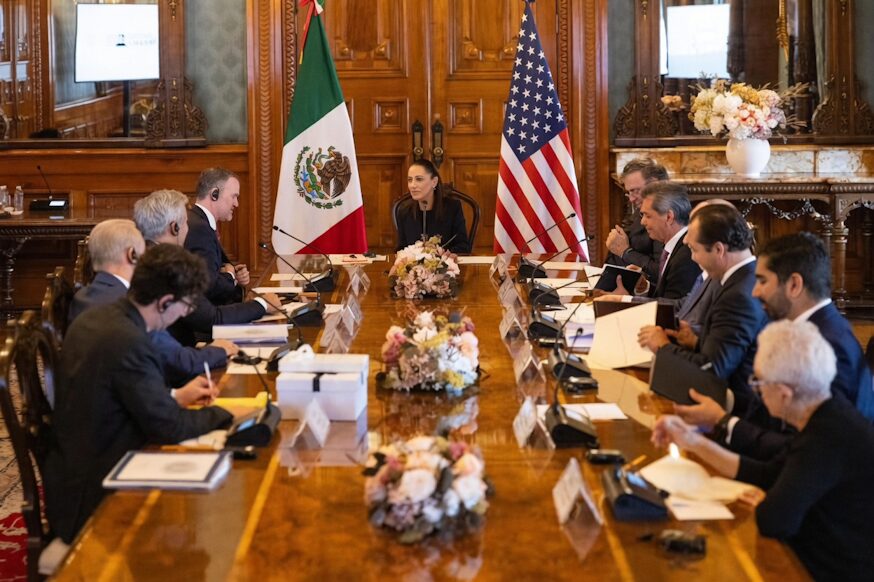
USMCA Mexico talks launch — and Canada is not in the room
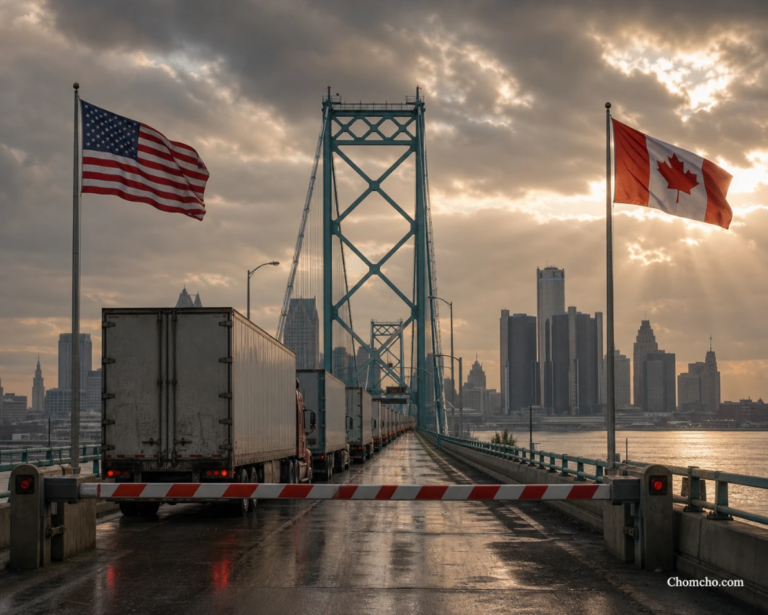
The Trump administration announced today, May 27, 2026, the launch of three rounds of bilateral trade negotiations with Mexico to revamp the North American trade agreement — with no mention of Canada whatsoever.
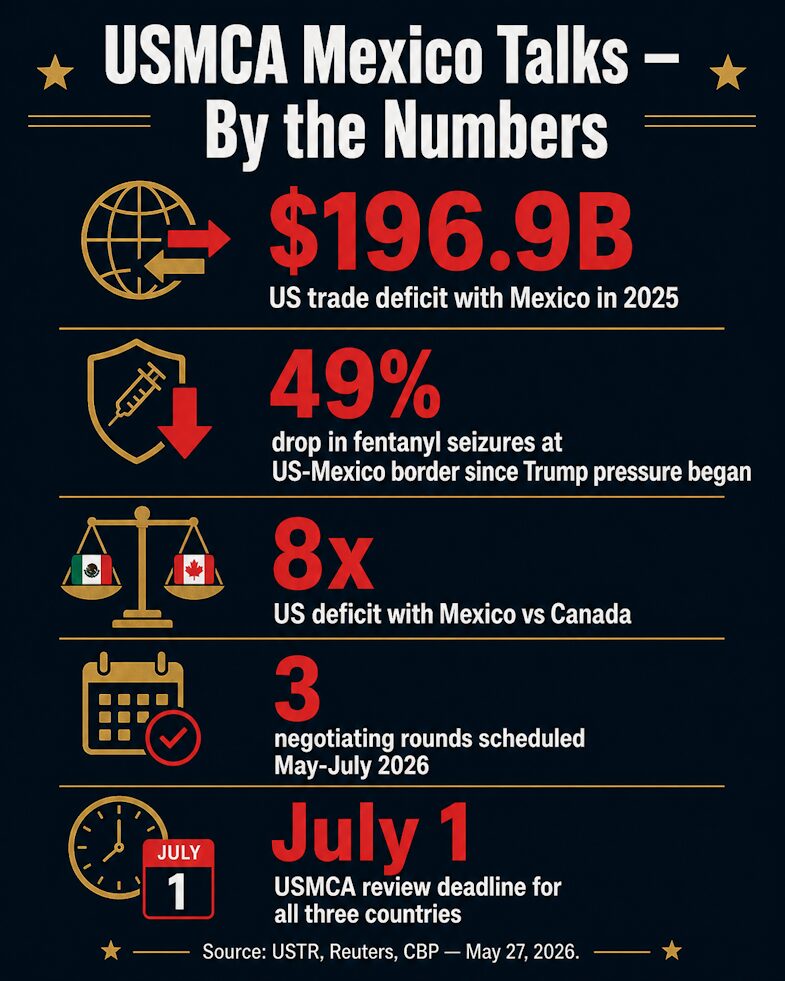
Deputy USTR Jeffrey Goettman leads the US delegation in Mexico City Thursday and Friday, focused on “economic security and rules of origin for key industrial goods.”
Round 2 follows June 16-17 in Washington, focused on agriculture and “a level playing field.” Round 3 returns to Mexico City the week of July 20.
The July 1, 2026 USMCA joint review deadline — when all three countries must decide whether to renew, withdraw, or continue negotiations — is now less than five weeks away.
USTR Jamieson Greer said the US intends to maintain tariffs even under a revamped USMCA, but Mexico could receive preferential treatment if deals are struck to protect North America from external goods — particularly Chinese transshipment.
Greer put it plainly: “I think that over the course of these negotiations, we are going to be talking about rules of origin in a way that enhances U.S. content in these goods.”
Mexico’s Economy Minister Marcelo Ebrard (@m_ebrard) said talks are “advancing” and called USMCA “essential for investment certainty.”
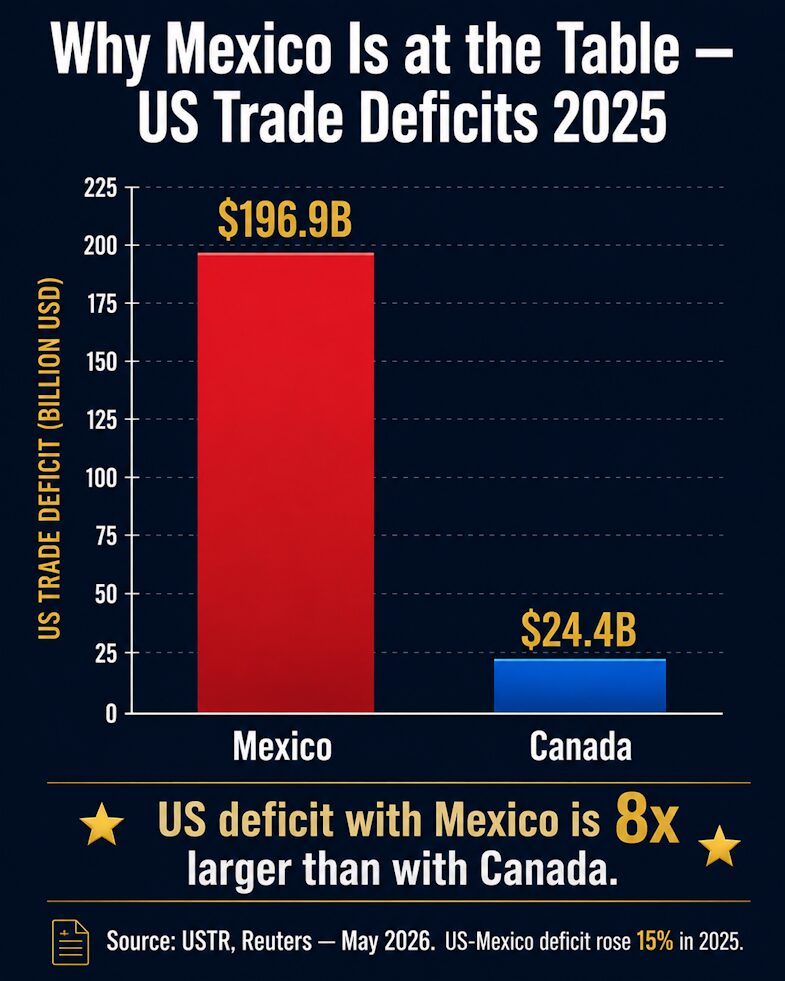
The US-Mexico trade deficit hit 196,900 million dollars in 2025, roughly 8 times larger than the US-Canada deficit.
That number alone explains why Mexico is at the table first. Canada is not mentioned. Not once.
Why Mexico first — fentanyl, deficits, and China’s backdoor
The USMCA Mexico talks are not purely about trade. They are about border security, fentanyl, and stopping China from using Mexico as a backdoor into the American market.
The mechanics are straightforward: Chinese manufacturers ship components to Mexican factories, assemble finished goods there, and export them to the US under USMCA tariff preferences — effectively bypassing US tariffs on Chinese goods entirely.
Washington wants that closed.
The US deficit with Mexico rose 15% to 196,900 million dollars in 2025.
That is the primary economic driver for prioritizing Mexico over Canada. But the security agenda runs equally deep.
Fentanyl seizures at the US-Mexico border fell 49% between January and March 2025 compared to the same period the year before — driven by Mexico deploying 10,000 National Guard troops to its northern border as part of its agreement with Trump.
Illegal border crossings have also collapsed dramatically.
Trump acknowledged Mexico has “stepped it up a lot” — but pressure continues.
Trump’s designation of drug cartels as Foreign Terrorist Organizations allowed the Treasury Department to issue sanctions on related entities, including a dozen Mexican companies supplying Los Chapitos in the Sinaloa Cartel network.
These are real achievements.
The USMCA Mexico talks are the next chapter — locking those security gains into a permanent trade framework that keeps China out and keeps American workers in.
Canada sidelined — and Carney’s anti-American pivot is why
Canada’s exclusion from the USMCA Mexico talks is not an accident.
It is a direct consequence of choices Prime Minister Mark Carney (@MarkJCarney) has made deliberately, publicly, and repeatedly.
At Davos in January 2026, Carney denounced what he called “American hegemony” and declared a “rupture” in the old world order — language universally understood as a direct attack on the Trump administration.
Then from a stage in Europe, he stated: “It is my strong personal view that the international order will be rebuilt, but it will be rebuilt out of Europe.”
He has toured European capitals, struck trade deals with China, declared Canada “the most European of non-European countries,” and traveled to Yerevan, Armenia to pitch his vision of a new world order designed to counterbalance US influence.
Even some Canadian commentators pushed back — one prominent analyst writing: “Canada isn’t a European country that drifted West. It’s a North American country built” on deep integration with the US economy.
Meanwhile Canada retaliated against US tariffs on vehicles, steel, and aluminum — the only country besides China to do so.
Ottawa also pulled US liquor from provincial shelves and is now negotiating to buy Swedish early-warning aircraft instead of American Boeing.
Greer said Tuesday the US has “significant” differences with Canada that will be “difficult to resolve.”
The Canadian dollar hit a six-week low on May 27 on the news. That is what anti-Americanism costs — in dollars and cents.

Bigger picture — Trump’s achievements and Mexico’s Marxist connections
The USMCA Mexico talks do not happen in isolation.
They sit inside a broader America First foreign policy picture that conservatives should both celebrate and watch carefully.
On the achievements: fentanyl seizures down nearly 50%. Illegal border crossings collapsed. Cartel FTO designations producing real sanctions on Sinaloa supply chains.
These are not talking points. These are documented results.
But Mexico under President Claudia Sheinbaum (@Claudiashein) maintains warm relations with Cuba — supplying oil to the Castro regime — and has been reluctant to fully break from Latin America’s Marxist axis that includes Cuba, Bolivia, Venezuela, and Nicaragua.
Mexico’s geopolitical ambiguity gives Washington legitimate leverage that goes far beyond trade deficits and rules of origin.
A Mexico that chooses the American economic orbit over the Havana-Caracas axis is a strategic win for the entire Western Hemisphere.
Trump’s America First trade pressure is the most powerful tool Washington has to make that choice happen.
The USMCA Mexico talks starting tomorrow are not just about auto content and agricultural parity. They are about which direction the Western Hemisphere faces in the next generation.
As R.C.H. Lenski once observed, a nation’s true alliances are revealed not in its declarations but in its transactions.
Mexico is at the table. Canada chose Europe.
The hemisphere is choosing sides — and America First is making sure the right side wins.