
This post is also available in:
 Português
  Español
  Français
  Deutsch
  Italiano
  Русский
  Nederlands
  日本語
日本語  Polski
G7 rare earths: the West wakes up — but is it too late?
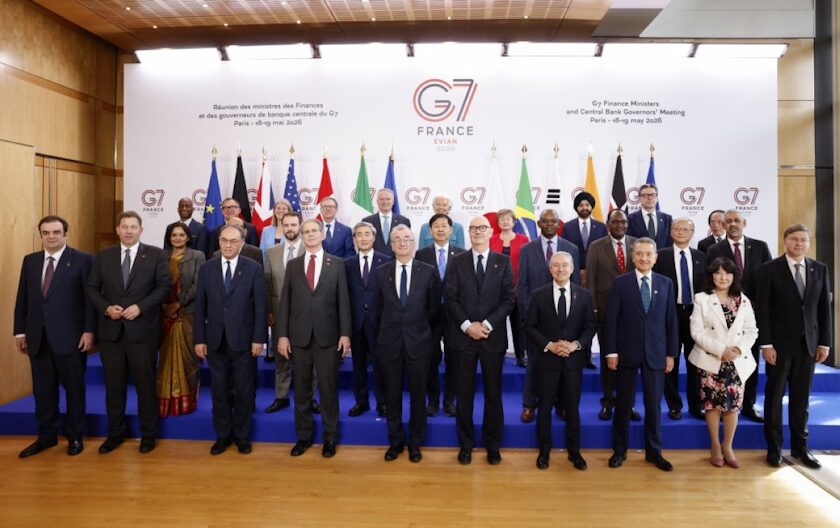
G7 rare earths finally made it to the top of the global agenda this week, as finance ministers and central bank governors from the world’s seven leading economies gathered in Paris in May 2026.
This meeting also included Brazil, India, South Korea, Kenya, and South Africa in a deliberate effort to broaden the coalition beyond the traditional Western club.
The message from Paris was clear, even if diplomatically worded.
French Finance Minister Roland Lescure (@RolandLescure) told journalists plainly: “We are facing significant challenges — war in the Middle East, multilateral imbalances that are not sustainable, and the stakes regarding rare earths and critical materials.”
He added what everyone in the room already knew: the G7 goal is to “ensure that we don’t depend on any one country — China, without naming names — for our rare earth supplies.”
The fact that he had to say “without naming names” tells you everything about how the globalist establishment still tiptoes around Beijing.
We at Chomcho.com will name the name: China. And the problem has been decades in the making.
The Hormuz factor — why this G7 rare earths meeting happened now
The timing of the G7 rare earths emergency is not accidental.
The ongoing U.S.-Iran conflict has virtually closed the Strait of Hormuz — the world’s most critical energy chokepoint, through which nearly 20% of all global oil supply passes — pushing oil above $103 per barrel and sending bond markets into volatility.
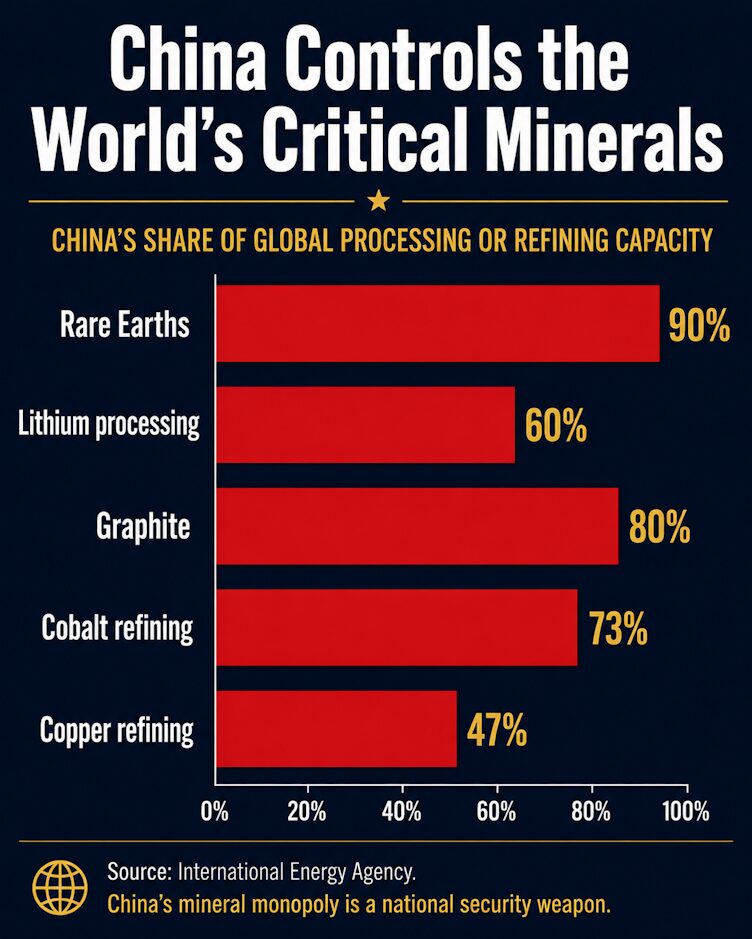
Now the West is staring at a nightmare scenario: what if China, which processes approximately 90% of global rare earths and 60% of global lithium, decides to weaponize that dominance in coordination with Iran and Russia?
If closing one strait can shake the entire global economy, imagine what cutting off 90% of the world’s rare earth processing can do.
That is not a hypothetical. That is the weapon Beijing is holding right now.
German Finance Minister Lars Klingbeil (@larsklingbeil) did not mince words: he warned the G7 had “no time to lose” as governments race to protect strategic industries.
He added: “What is very important to me is that we in Europe do not sit back. Neither complaining nor self-pity helps us — we have to become active.”
That is a remarkable admission from a German finance minister. Europe built its entire post-war industrial model on cheap Chinese inputs and Russian energy.
Both pipelines are now broken.
Lescure put the historical stakes in stark terms: “We must do for critical materials what we did with energy in the 1970s.”
After the 1973 oil shock, the West built strategic reserves and diversified. It took a decade. The rare earth shock is already here.
The clock is already running.
The G7+ strategy — building a China-free rare earth supply chain
G7 rare earths policy is now moving beyond talk and into coalition-building.
U.S. Treasury Secretary Scott Bessent (@SecScottBessent) confirmed that Australia and India were invited to the Paris meeting alongside Brazil, South Korea, Kenya, and South Africa — each chosen for a specific strategic reason.
Brazil holds massive rare earth reserves and niobium deposits, with Vale (Brazil’s mining giant) and the U.S. Development Finance Corporation already in discussions.
India brings critical processing capacity, though Washington is working hard to keep New Delhi non-aligned on minerals given its ongoing ties with Moscow and Beijing.
South Korea brings world-class battery and magnet manufacturing.
Kenya represents the G7’s Africa strategy — developing critical mineral resources outside Chinese Belt and Road financing.
France itself has set a bold national target: by 2030, producing rare earth oxides to cover 100% of European demand for heavy rare earths and about a quarter of demand for light rare earths.
To back that up, a French-Japanese processing factory is already under construction in southwest France, with 106 million euros in French state investment already committed.
That is not a promise. That is a shovel in the ground.
The coalition is forming. The question, as always with the globalist-built West, is whether it will move fast enough.
China’s rare earth monopoly — a weapon, not a market
Let’s be honest about what G7 rare earths discussions are really about: war preparedness.
China did not stumble into rare earth dominance by accident.
According to the International Energy Agency, China currently refines between 47% and 87% of copper, lithium, cobalt, graphite, and rare earths globally — minerals essential for defense systems, semiconductors, electric vehicles, and advanced military technology.
Beijing achieved this through decades of heavy state investment and predatory pricing that drove Western competitors out of the market entirely.
The globalist establishment cheered it on as “free trade.”
It was never free trade. It was strategic economic warfare.
Experts now warn that even with massive Western investment, building alternative rare earth supply chains could take years — or even decades.
China knows this.
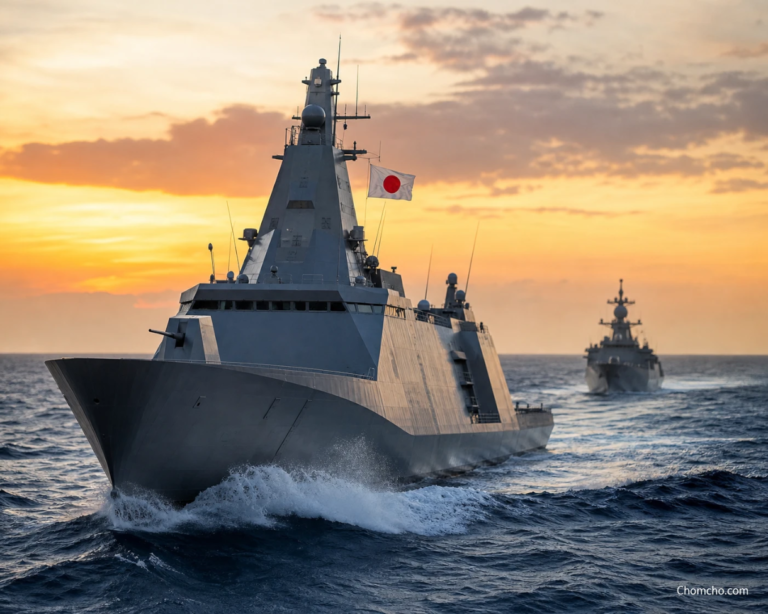
That is precisely why it imposed strict export controls on rare earths to Japan just weeks before the Paris G7 meeting.
The Bible warns in Proverbs 22:3: “A prudent man sees danger and takes refuge, but the simple keep going and pay the penalty.”
For thirty years, the West was not prudent. It saw the danger — the dependency, the concentration, the vulnerability — and kept going anyway, lured by cheap prices and globalist ideology.
Paris 2026 may be the moment the West finally decided to take refuge.
We pray it is not too late.
Because if China ever pulls the rare earth trigger in a full confrontation, the West’s military and technological machine grinds to a halt.
That is not a metaphor. That is physics.