
This post is also available in:
 Português
  Español
  Français
  Deutsch
  Italiano
  Русский
  Nederlands
  日本語
日本語  Polski
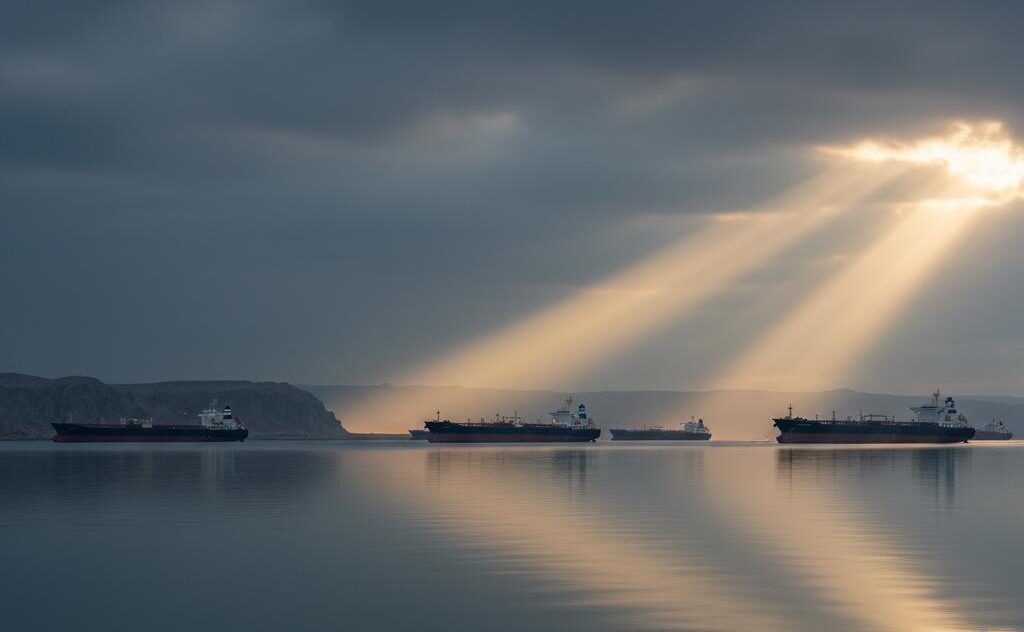
Two UN resolutions, one Strait — and the West is split
The Strait of Hormuz is choking the world’s economy. Nearly 20% of all global oil passes through that narrow waterway every single day.
For three months, Iran has virtually closed it — and the Western response at the United Nations has been two competing draft resolutions that cannot agree on how to respond.
France has drafted a UN Security Council resolution on setting up an international mission to restore movement in the Strait of Hormuz, and could submit it if conditions are right — as Washington struggles to bring to a vote a text Russia and China may say is biased against Tehran.
Brent crude is currently trading at approximately $105 per barrel, with independent analysts projecting prices reaching $154 per barrel if the closure extends to twelve weeks.
Two hundred dollars per barrel is no longer considered an extreme scenario. That is not an abstraction.
That is your gas bill, your grocery bill, and your heating bill — all exploding at once.
The world is watching. And the West is arguing with itself at the UN while Iran holds the tap.
The US-Bahrain draft — what it demands and why it’s stalled
The US-Bahrain draft resolution is direct. Unambiguous.
It demands Iran halt attacks and mining in the Strait of Hormuz immediately.
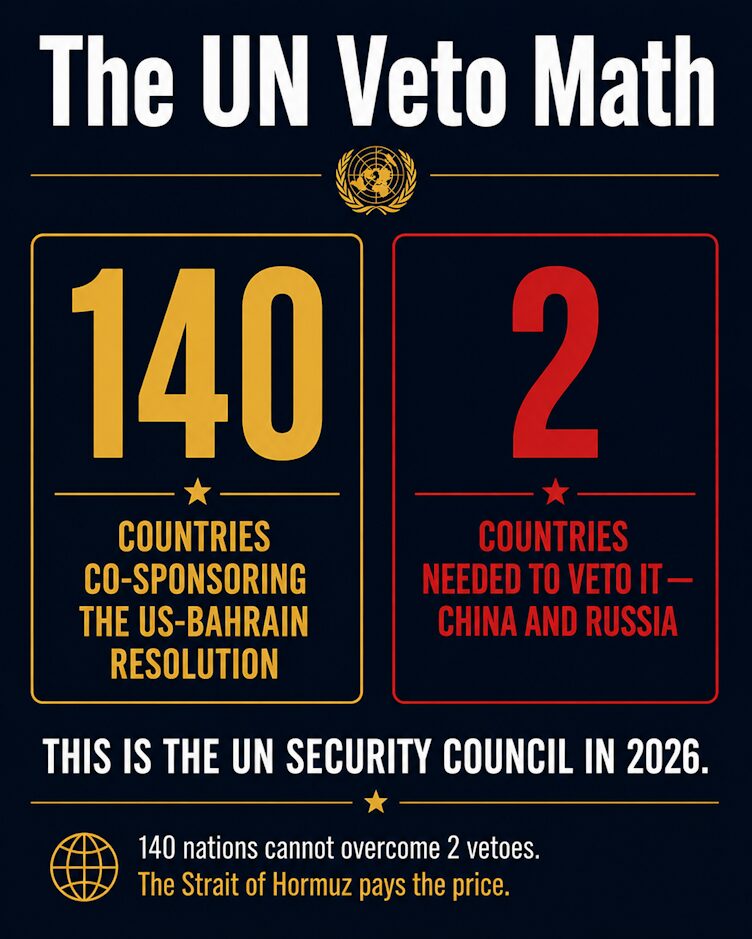
Washington pulled off a remarkable diplomatic achievement — securing approximately 140 co-sponsoring countries behind the text.
140 countries.
Yet the vote has been repeatedly delayed. Why?
Because two countries are enough to kill it. China and Russia vetoed a similar US-backed text in April, arguing it was biased against Tehran.
They will almost certainly do it again.
France — itself a permanent veto-wielding member of the Security Council — has so far refused to back the US text. Paris argues it is diplomatically doomed from the start.
French Foreign Ministry spokesman Pascal Confavreux (@francediplo_EN) said the US-Bahrain draft “forms the basis of current discussions” — but no vote date has been set.
140 countries behind a resolution. Two countries with a veto ready.
This is the UN Security Council in 2026 — a system that consistently rewards aggression and punishes clarity.
America First conservatives have said it for years: the UN is broken. This is the proof.
The French draft — softer language, broader buy-in, or just appeasement?
France’s competing draft takes a deliberately different approach.
It does not explicitly demand that Iran halt its mining operations in the Strait of Hormuz. It does not condemn Tehran by name.
Instead, it calls for an international mission to restore freedom of navigation — with language carefully crafted to avoid triggering a Russian or Chinese veto.
French Foreign Ministry spokesman Pascal Confavreux confirmed Paris is working on an international mission focused on restoring maritime movement and protecting commercial shipping in the strait.
But here is the part that should alarm every American.
French President Emmanuel Macron (@EmmanuelMacron) has said he supports a UN framework for any action in the strait but has refused to take part in immediate operations, insisting international efforts could only proceed once hostilities calm and with Iran’s consent.
Read that again slowly. With Iran’s consent.
France is asking the arsonist for permission to call the fire department.
The US view is that the French text doesn’t go nearly far enough. They are right.
Soft language didn’t stop Hitler. It didn’t stop Stalin. And it won’t stop Tehran.
China, Russia, and the veto that protects Iran
The real story behind both Strait of Hormuz resolutions is not France versus the United States. It is China and Russia using the UN Security Council as a diplomatic shield for Tehran.
Every time the West drafts clear language holding Iran accountable, Beijing and Moscow reach for their veto. This is not a legal argument. It is a geopolitical weapon.
China needs the West’s energy supply disrupted to weaken its industrial competitors. Russia needs oil above $100 per barrel to fund its war machine in Ukraine.
Both powers have every incentive to keep the Strait of Hormuz crisis alive as long as possible.
Iran created the Persian Gulf Strait Authority and now requires formal clearance plus fees of up to 2 million U.S. dollars per vessel — payable in Chinese yuan or cryptocurrency to bypass Western sanctions — essentially a toll booth on the world’s energy supply, backed by Russian and Chinese diplomatic cover at the UN.
The Book of Proverbs warns that a wicked man accepts a bribe in secret to pervert the course of justice (Proverbs 17:23).
Russia and China are not accepting bribes — they are trading vetoes for oil, for yuan, and for strategic advantage.
The perversion of justice at the Security Council is just as real. And the consequences fall on ordinary people around the world paying $105 per barrel and rising.
Trump’s bilateral deal with Iran may be the only real path forward. Because the UN, as usual, is not the solution. It is part of the problem.
The Strait of Hormuz will not be freed by resolutions. It will be freed by strength.