
This post is also available in:
 Português
  Español
  Français
  Deutsch
  Italiano
  Русский
A revolution anniversary ends with a wall of laws
For the many people in the world who know nothing about this country, the headline sounds striking: Nicaragua without elections.
Something terrible must have just happened.
But those who know even a little about Nicaragua understand that this is just a formality. The pretense is finally gone. There have been no real elections in Nicaragua for about two decades.
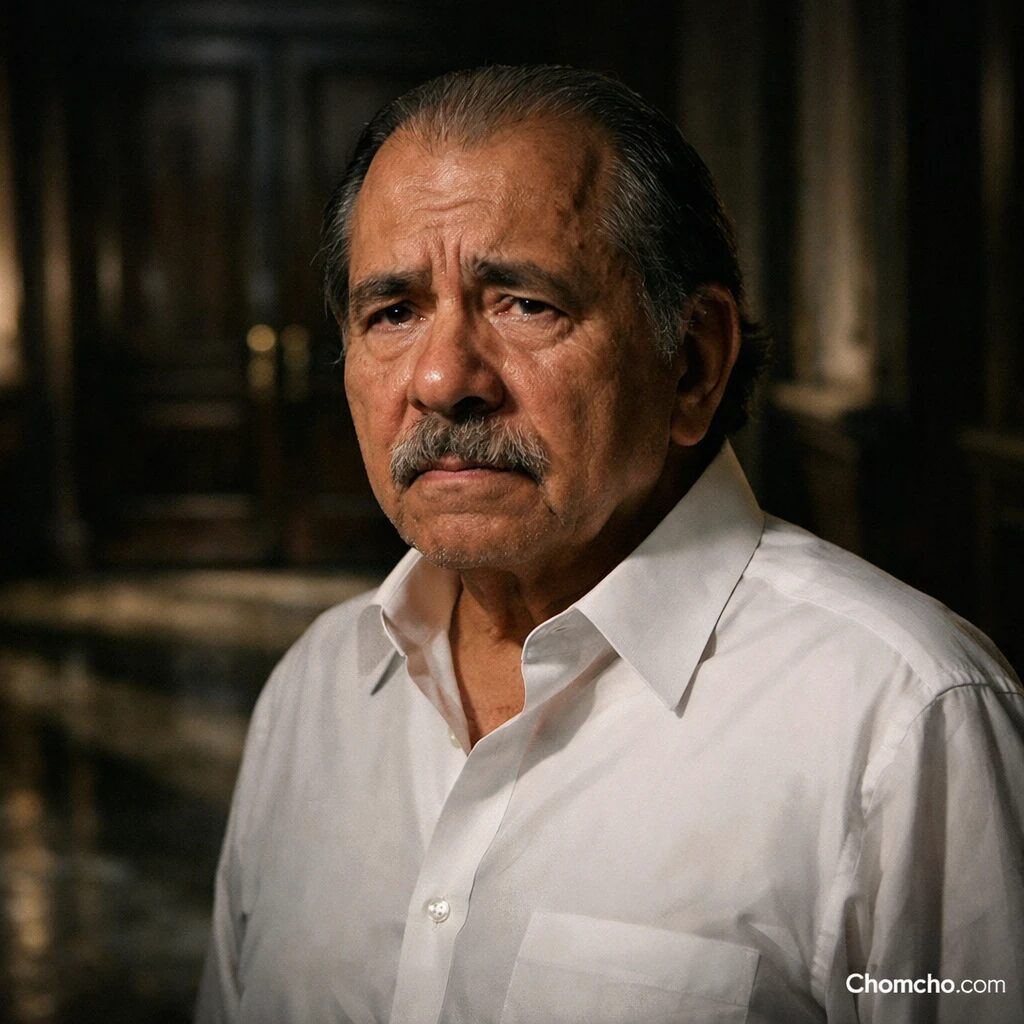
On Sunday, July 19, during the 47th anniversary of the Sandinista Revolution, President Daniel Ortega, 80 years old, announced that his country will never hold elections again.
“There won’t be any more elections here,” he said, promising that his congress would build what he called a wall of laws against political parties he describes as coup plotters paid by “the Yankees.”
Two days later, his congress announced it will write the change into the constitution. The election scheduled for November 2027 is canceled.
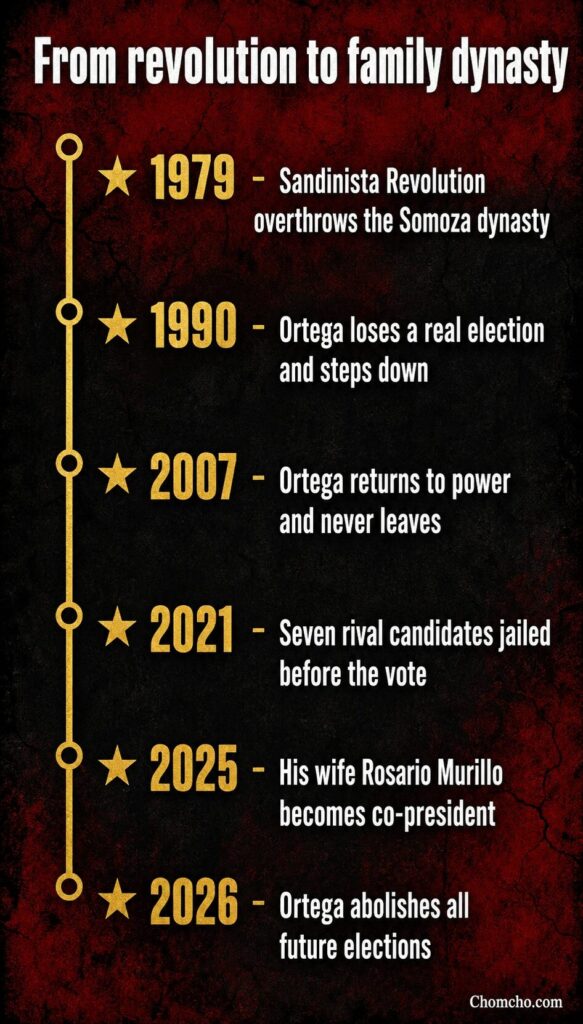
The last vote with any appearance of competition was in 2021, and even that one was a theater piece: Ortega jailed seven rival candidates before the election.
The Organization of American States called it the worst election possible.
From revolution to family dynasty
A quick history helps.
In 1979, the Sandinista Revolution overthrew the Somoza family, a dynasty that had ruled Nicaragua for more than 40 years.
Ortega emerged as the leader of the new government.
During the 1980s, the United States under President Reagan backed the Contra rebels against him, a covert CIA program that ended in the Iran-Contra scandal in Washington.
Then came the great surprise of Ortega’s life.
In 1990, he allowed a real election and lost it to Violeta Chamorro. He handed over power. It was the one democratic act of his career.
He returned to the presidency in 2007 and never left, winning votes in 2011, 2016 and 2021 that critics describe as rigged.
The revolutionary who overthrew one family dynasty spent the next decades building his own.
The family runs Nicaragua like a monarchy
Look at the official positions.
Last year, Ortega changed the constitution and elevated his wife, Rosario Murillo, to the invented office of co-president. She now rules beside him.
Their children hold posts as presidential advisors, and in April the United States sanctioned two of their sons.
What happens to those who challenge the family?
Three examples tell the story.
Juan Sebastián Chamorro, a presidential candidate in 2021, was jailed, then expelled from the country and stripped of his Nicaraguan citizenship.
Hugo Torres, a former Sandinista general who broke with Ortega, died in 2022 inside a Managua prison at age 73.
And Humberto Ortega, the president’s own brother and former army chief, was placed under house arrest in May 2024 after saying in an interview that his brother’s rule was headed for disaster.
He died four months later, still under police guard.
When a man imprisons his own brother because of one interview, no throne room is needed.
Nicaragua is a monarchy in everything but the crown.
Fear behind the wall of laws
The timing reveals the motive.
Six months ago, on January 3, United States forces entered Caracas and captured Venezuelan ruler Nicolás Maduro.
Ortega called that operation “monstrous” in the same July 19 speech. After the raid, his government even promised to release more prisoners, an apparent attempt to lower the pressure on itself.
Analyst Tiziano Breda of the conflict monitor ACLED said Ortega and Murillo are “evidently afraid” that even the smallest political opening could threaten their hold on power.
That is the honest reading of the announcement. Confident rulers hold elections they know they control. Frightened rulers abolish them.
Walls are built by scared men.
Christians persecuted in Nicaragua
The repression has a religious face, and it strikes all Christians.
Since 2018, the regime has shut down more than 5,000 organizations, most of them religious.
Human rights groups counted about 1,200 hostile actions against the Catholic Church between 2019 and 2023, with priests and nuns expelled or imprisoned.
Evangelical Christians suffer too.
In December 2023, the regime arrested 11 Nicaraguan Evangelical pastors working with Mountain Gateway, a Texas-based ministry.
Their crime was preaching: one month earlier, their campaign had gathered more than 250,000 people in Managua.
The pastors were sentenced to between 12 and 15 years in prison on fabricated charges of money laundering, fined more than 80 million dollars each, denied Bibles in prison, and given dirty water to drink.
They were released in September 2024 and banished from their own country, stripped of citizenship.
Jesus prepared His followers for this: “Blessed are those who are persecuted because of righteousness, for theirs is the kingdom of heaven.”
The Ortega family can close churches and jail pastors, but 250,000 Nicaraguans in one plaza show that the Gospel is alive in Nicaragua.
A regime that fears preachers is a regime that is afraid of its own people.
The dictator club stays silent
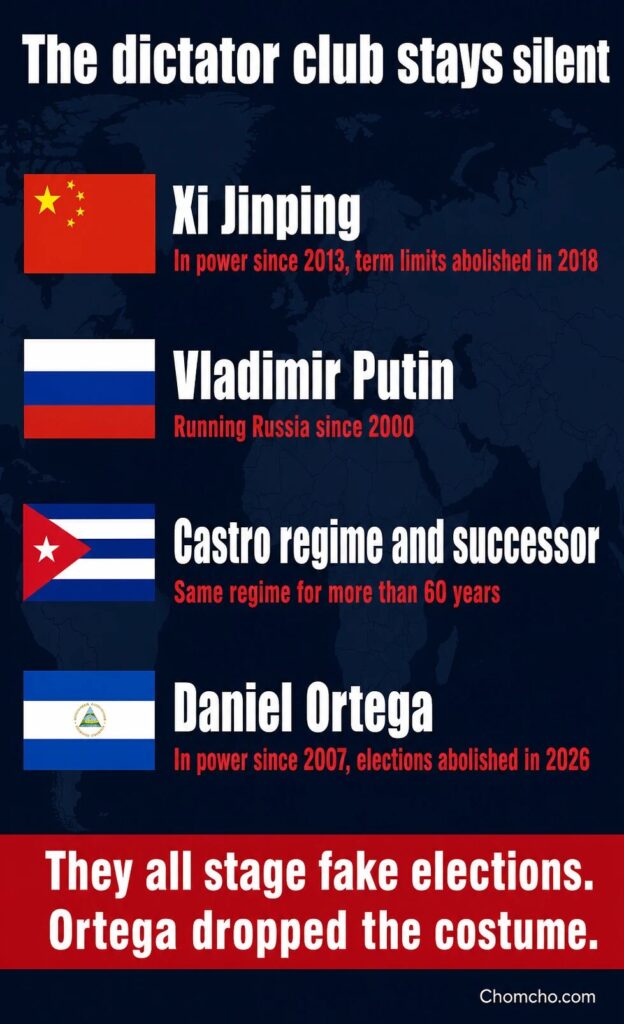
Notice who has said nothing: China, Russia, Cuba and Venezuela. The silence is easy to explain. You cannot criticize a mirror.
Xi Jinping abolished presidential term limits in China in 2018 and can now rule for life. Vladimir Putin has run Russia since 2000, a quarter of a century.
In Cuba, the Castro brothers governed for more than 60 years, and the current president, Miguel Díaz-Canel, is a successor chosen by the same regime, not by voters.
All of these governments still stage elections without real competition, because the ritual is useful for appearances. Ortega just did what none of them dares to do: he dropped the costume.
The democracies did speak.
Secretary of State Marco Rubio (@marcorubio) said the Ortega family has “abandoned even the pretense of popular consent” and called on the world to end business as usual with Managua.
The head of the OAS said Ortega abandoned democracy completely. The United Nations human rights chief condemned the move.
And Europe?
The European Parliament recommended suspending its trade agreement with Nicaragua, but a recommendation is not a suspension.
So far, the European reaction is words without actions.
America cannot fix every dictatorship
Washington has been tougher on Cuba and Venezuela than on Nicaragua, and there are practical reasons.
Venezuela has enormous oil reserves. Cuba has a large and politically powerful community of Cuban American voters.
Nicaragua has neither, and the United States cannot get involved everywhere. A serious foreign policy must prioritize.
Still, America holds real leverage without firing a shot.
The United States is Nicaragua’s most important export market, and the State Department has linked the regime to illegal immigration flows that harm American security.
President Trump (@realDonaldTrump) proved in Venezuela that with him there is no business as usual for hostile dictators. Ortega saw what happened to Maduro. That is why he is building walls.
And there is one wall no dictator can build.
Ortega is 80 years old. Murillo is 75. No law passed in Managua can stop time, and when God decides, Nicaragua’s story will change.
Until that day, let’s pray for the persecuted Christians of Nicaragua, and let’s pray that the country will one day vote again in real elections.