
This post is also available in:
 Português
  Español
  Français
  Deutsch
  Italiano
  Русский
  Nederlands
  日本語
日本語  Polski
When the earth shook, America came: the geopolitics of the Venezuela earthquake 2026
At 6:04 in the evening on June 24, 2026, the ground beneath northern Venezuela began to move.
Thirty-nine seconds later, it moved again.
Two massive earthquakes struck in rapid succession — first a magnitude 7.2, then a 7.5 — making this the strongest seismic event to hit Venezuela since 1900.
The epicenter was near San Felipe in Yaracuy state, roughly 160 kilometers west of Caracas.
As of July 3, 2026, the confirmed death toll stands at 2,295. More than eleven thousand people are injured. Tens of thousands remain missing.
The UN has already procured 10,000 body bags in anticipation of the toll rising further. The U.S. Geological Survey warns the final count could exceed 10,000 dead.
Over 250 structures collapsed, including high-rise residential buildings in Caracas and La Guaira. Hospitals are overwhelmed and running out of supplies.
Electricity, water, internet, and gas failed simultaneously across the hardest-hit areas. Eight hospitals were forced to close.
The UN estimates total economic damage at 37,000 million dollars — roughly 6% of Venezuela’s GDP.
UNICEF reports 1.8 million people need humanitarian assistance, including 680,000 children.
This is the worst natural disaster in Venezuela’s modern history.
America came first and came hardest — the Venezuela earthquake 2026 response
The geopolitical irony could not be sharper.
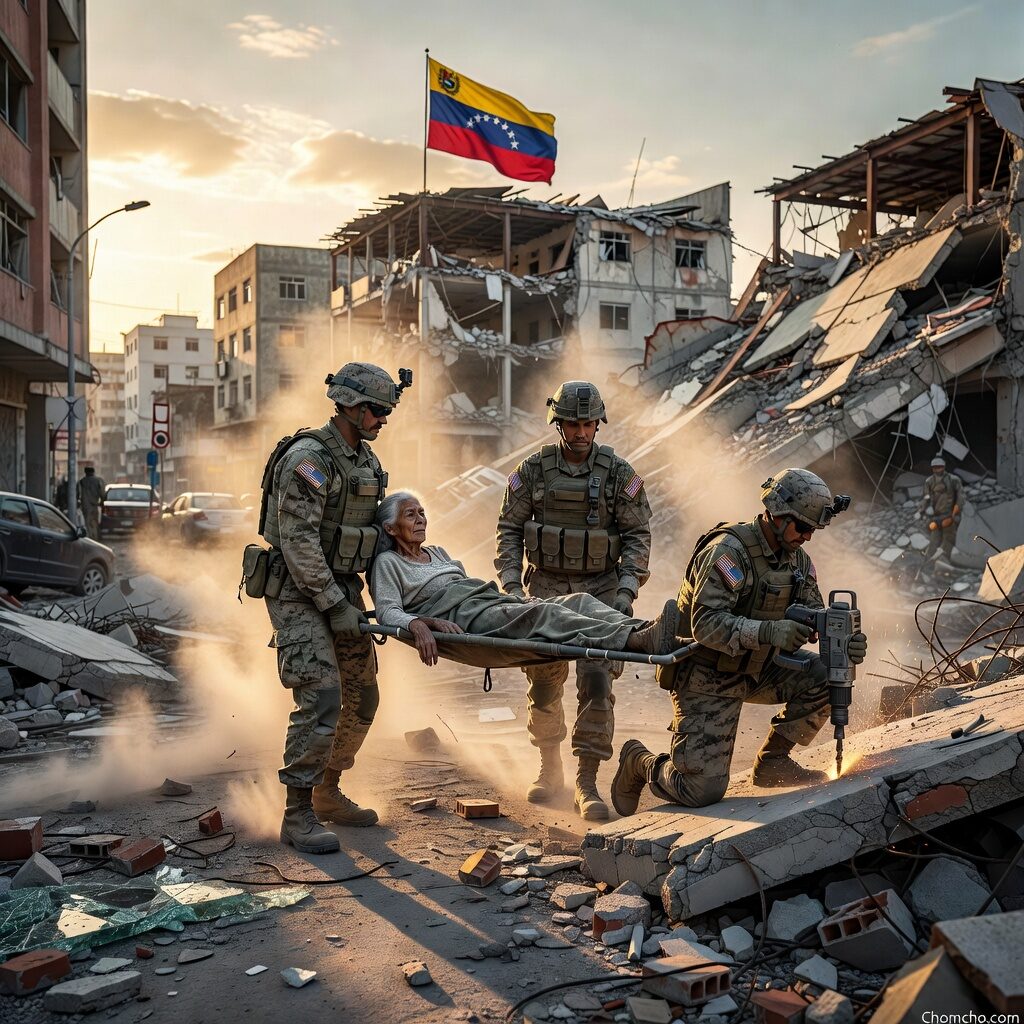
Just six months ago, U.S. Special Forces seized former Venezuelan President Nicolás Maduro from Caracas. As of July 4, 2026, U.S. Marines are on Venezuelan soil — not to capture anyone, but to save lives. History rarely moves this fast.
Within hours of the earthquakes, President Trump posted on Truth Social: “The two major earthquakes that just hit the great people of Venezuela are both massive in scale and have left a devastating number of deaths. The U.S.A. stands ready, willing, and able to help! We will be there for our new and great friends.”
The Trump administration then backed those words with the largest international earthquake response in Venezuela’s modern history.
More than 310 rescue specialists were deployed from Fairfax County Virginia, Los Angeles, Miami-Dade, and Miami City — each team including firefighters, physicians, structural engineers, and canine search specialists with years of international deployment experience.
U.S. Air Force C-17 Globemasters transported the teams and over 200,000 pounds of specialized equipment.
U.S. Marine Corps MV-22 Ospreys conducted aerial surveys.
The USS Fort Lauderdale positioned off the coast of La Guaira, delivering supplies directly to the most affected coastal areas by amphibious craft.
A specialized U.S. naval team deployed to repair the damaged Port of La Guaira. U.S. teams also repaired a damaged runway at Simón Bolívar International Airport — essential for the flow of all international aid.
Starlink terminals were deployed to restore internet communications across the blackout zones.
U.S. Marine Corps Major General Kevin J. Jarrard, SOUTHCOM’s senior official on the ground, met personally with Acting President Delcy Rodríguez to coordinate operations.
SOUTHCOM Commander General Francis Donovan led the overall effort from Miami.
The U.S. financial commitment reached over 300 million dollars, the most generous humanitarian pledge to Venezuela in history, channeled through Samaritan’s Purse, Catholic Relief Services, World Vision, the World Food Programme, and OCHA.
Acting President Delcy Rodríguez said it plainly: “Venezuela will never forget the hand extended to our people in these hard hours.”
This is what America First looks like in Latin America. Not threats. Not sanctions alone. Strength used to save lives.
Who came, who pledged, and who was silent
More than 2,000 rescue workers from 27 countries responded. Over 137 search dogs deployed.
The list of nations that sent real help is long and moving: Mexico, Colombia, El Salvador, Spain, Chile, Argentina, Brazil, Canada, Turkey, Peru, Panama, Ecuador, Dominican Republic, Guatemala, Paraguay, Switzerland, Portugal, Costa Rica, and many more.
Special recognition goes to countries that had no political obligation to be there but came anyway:
Turkey, Switzerland, Portugal, Jordan, Lithuania, Serbia, and others who sent specialists and aid workers thousands of kilometers from home.
They will not make the headlines. They deserve to.
Spain’s Emergency Military Unit also sent specialized rescue teams and search dogs. A Spanish team pulled a woman from under rubble after she had been trapped for nearly 72 hours.
Pedro Sánchez has been a controversial and often frustrating figure for conservatives, but Spain’s military rescue unit earned real respect in Venezuela.
Pope Leo XIV sent an emergency donation of 100,000 euros as a first step, with more promised as needs were identified.
Brazil sent a field hospital, 36 firefighters, nine tons of equipment, and 100 solar-powered water purifiers. Brazil helped. Not as dramatically as some others, but they came.
Then there is China. Beijing pledged approximately 14 million dollars in emergency aid — a modest sum from the world’s second largest economy and Venezuela’s self-described “strategic partner” for 25 years.
Satellite imagery was provided. Some relief supplies were promised. But no Chinese rescue workers arrived.
No Chinese search dogs deployed. No boots on the ground from the country that spent two decades calling Maduro’s Venezuela a beacon of resistance against American imperialism.
Russia sent nothing. No rescue workers, no search dogs, no monetary pledge of any significance, no meaningful statement of solidarity.
For a country that claimed Venezuela as a geopolitical ally and deployed military advisers there for years, the silence was complete.
Honduras President Nasry Asfura said honestly: “May God forgive me, but I must look out for every Honduran first. I am sure Venezuela will receive plenty of help from other countries.”
Honduras has a GDP of roughly 41,000 million dollars and is one of the poorest countries in Central America. His words were painful, but they were honest.
He did not pretend. He did not send a symbolic gesture he could not afford.
There is something to be respected in that honesty, even when the circumstances make it hard to hear.
The shadow over the rubble — Diosdado Cabello
While rescuers worked around the clock to pull survivors from collapsed buildings, Venezuela’s Interior Minister Diosdado Cabello became the dark symbol of everything broken about the country’s system.
Cabello is indicted in the United States on narco-terrorism charges. The U.S. State Department offers a $25 million bounty for information leading to his capture.
He has been described as one of the top leaders of the Cartel of the Suns, a cocaine-trafficking network operating through the Venezuelan military.
A viral video caught him physically blocking a Virginia USAR Task Force 1 rescue worker from reaching a person crying for help beneath the debris.
The American rescuer: “There’s someone right here yelling for help.”
Cabello: “Back up. Back to the truck.”
Rescuer: “I’m not happy with this situation.”
Venezuelan journalist Carlos Salazar alleged on NTN24 that Cabello was blocking access to certain buildings in La Guaira to protect hidden cash, possibly as much as 250 million dollars and cocaine stashes buried inside 120 to 250 collapsed apartment complexes.
The allegations could not be independently verified, but they set off a firestorm in the United States.
U.S. Representative Carlos Giménez called for Cabello’s immediate arrest: “While the U.S. increases its presence in Venezuela, we should pick up thug Diosdado Cabello and bring him to justice so he can stop impeding the distribution of aid.”
Congresswoman María Elvira Salazar was equally direct: “Only a criminal would stand between rescuers and those trapped under debris. And that’s exactly what Diosdado Cabello is.”
The State Department diplomatically called it “an unfortunate misunderstanding between a member of a U.S. urban search and rescue team and the interim Venezuelan authorities.”
Meanwhile, four Venezuelan police officers from the CICPC were caught on viral video stealing dollar bills from the earthquake rubble. A civilian woman confronted one, grabbed his bag of cash, and ripped the bills into pieces over the debris while in tears.
And in La Guaira, civilians and volunteer rescue crews dug with their bare hands while armed soldiers stood nearby.
A volunteer rescue worker shouted at them: “Why did you bring weapons? You should have brought a shovel, a pickaxe. We’re not at war. We’re in an emergency.”
Bukele and the small country with the biggest heart
If Trump and SOUTHCOM were the geopolitical heroes of the Venezuela earthquake 2026, Nayib Bukele of El Salvador was the human one.
El Salvador has a population of 6.4 million and a GDP of 40,000 million dollars. It is one of the smaller economies in Latin America.
But Bukele sent 300 rescuers and paramedics plus 50 metric tons of humanitarian aid — and then he personally got involved in a way no other leader did.
Bukele announced on X that his teams had located 15-year-old Camila Sofía Medina Rivas alive on the ninth floor of a collapsed building in Catia La Mar, trapped with her dog Chanel.
His teams broke through several walls to reach her. He shared the audio of the rescue conversation: “We are here to help you, to get you out as soon as possible. We want you to stay strong always.”
He also personally posted about rescuing a dog named Giselle, trapped five days under the rubble: “After 5 hours, we managed to rescue this little dog.”
And then came Hernán Gil. A security guard buried under 140 tons of concrete.
Rescue teams first made contact with him four days after the earthquake. They fed him through a syringe while working tirelessly to free him.
Seven nations — Venezuela, Chile, the United States, Portugal, Costa Rica, El Salvador, and Mexico — worked together around the clock for three days.
On July 2, eight days after the earthquake, they pulled Hernán Gil out alive.
Bukele posted the moment in capital letters: “WE FINALLY MANAGED TO RESCUE HERNÁN!”
Gil’s wife Gusbimar González told AFP: “I’m completely amazed because it’s the first time I’ve seen so many countries come together like this to save a single person.”
That sentence says everything about what happened in Venezuela over the last ten days.
The heroes with four paws
And now, the part that made the world smile even through the grief.
Among the 137 search dogs deployed from around the world, a remarkable group of canines became the true heroes of the Venezuela earthquake 2026.
From Panama came Blade. From Peru, Kayra, a Belgian Malinois from the Voluntary Firefighters Brigade. From Colombia, Dastan, Rojo, Candy, and Tamy. From El Salvador, Rambo. From Mexico, Cairo — a Belgian Malinois from the elite Grupo Jaguares de Nuevo León — along with Orly, Balam, Kenai, and Halley.
One Mexican rescue dog was injured during operations and had to be transported back to Mexico for medical treatment, his duty heroically done.
And then there is Tsunami.
Tsunami is a Venezuelan rescue dog. But before he was a hero, he was a stray.
Abandoned on the streets of Venezuela, he was rescued by civil protection teams, trained, and given a purpose.
Now he wears the Venezuelan flag patch on his vest and the words “Rescatista Canino” on his chest.
In the Venezuela earthquake 2026, Tsunami searched through the rubble of his own country looking for the living among the ruins.
From street dog to national hero.
El Salvador’s teams also rescued Giselle — a little dog herself pulled from five days under the rubble, blinking into the light. She saved no one. She needed saving. And Bukele’s team gave her five hours.
Because in the middle of a human disaster, the rescue of a small dog is not a distraction from the tragedy.
It is the proof that humanity is still present in it.
A medal for Tsunami, our four-legged hero
Someone on X suggested that Trump should give Tsunami a Medal of Honor.
We think that is a fine idea.
In all seriousness — these dogs represent the best of this story.
Nations that have fought each other diplomatically, imposed sanctions on each other, and traded insults at the United Nations, came together over the simple imperative of saving lives buried under concrete.
The Venezuelan people will rebuild. They always have. And when they do, they will remember who came.
They will remember Trump saying “We will be there for our new and great friends.”
They will remember Bukele posting “WE FINALLY MANAGED TO RESCUE HERNÁN!”
They will remember the dogs.
And perhaps, from the rubble of this disaster, something new is being born in Venezuela. A country the world came to save is a country the world believes is worth saving.
Venezuela, we are with you.