
This post is also available in:
 Português
  Español
  Français
  Deutsch
  Italiano
  Русский
  Nederlands
  日本語
日本語  Polski
Europe wants a seat at the table it refused to defend in Europe’s toothless diplomacy
The 14-point Memorandum of Understanding (MOU) between Washington and Tehran, signed at the Palace of Versailles following the G7 Summit in Evian, France, starts a 60-day clock for formal nuclear negotiations.
However, Europe was not at the Iran table.
Mediation was led by Pakistan and Qatar, with no formal European role anywhere in the process.
Now, European Union Foreign Policy chief Kaja Kallas is telling the European Parliament there are “grounds for cautious optimism” and that Europe’s nuclear expertise makes its participation “indispensable.”
Iran’s own Foreign Minister Abbas Araghchi answered that claim months before Kallas made it.
He described the E3, France, the United Kingdom, and Germany, as “irrelevant” to the current process, and noted that nuclear mediation had moved from Europe to the region, where the heavy lifting was being done by Oman and Qatar.
That verdict, delivered not by Washington but by Tehran itself, frames everything that follows.
Europe’s history with Iran, and the Holier than Thou attitude during the conflict
Europe’s E3 did carry genuine historical weight in Iran nuclear diplomacy.
They were key architects of the 2015 Joint Comprehensive Plan of Action (JCPOA), the landmark agreement that limited Iran’s nuclear program in exchange for sanctions relief.
After the US withdrew in 2018, the E3 maintained a go-between role with Tehran and Washington.
As recently as June 2025, E3 foreign ministers met Iranian Foreign Minister Araghchi in Geneva to urge de-escalation. That history is real.
What is also real is what happened when the shooting started in February 2026.
Spain’s Defense Minister Margarita Robles called the war “profoundly illegal and profoundly unjust,” and Prime Minister Pedro Sánchez’s government refused to allow American aircraft to use Spanish bases or airspace.
Italy denied a US request for aircraft to land at a base in Sicily.
France’s Emmanuel Macron said at an EU summit that defending international law and promoting de-escalation was “the best we can do.”
He then added: “I have not heard anyone here express a willingness to enter this conflict, quite the opposite.”
Secretary of State Marco Rubio (@marcorubio) publicly criticized NATO allies for refusing the United States access to bases during the war.
This was the posture of Europe’s leaders while American and Israeli forces bore the full cost of confronting a regime that Europe itself had long designated a nuclear threat.
The Holier than Thou attitude ran deep.
Every condemnation of US action came wrapped in the moral language of international law and multilateral process, from the very bloc that had spent years warning the world about Iran’s nuclear ambitions, and then stepped aside when it came time to act.
And yet not one European government delivered the same moral lectures to the Iranian regime that was closing the world’s most critical shipping lane and threatening 20 percent of global oil supply.
Israel, by contrast, fought as a lion for its own survival, with no apologies and no lectures to offer, while Europe had the nerve to condemn Israel and press for new sanctions and isolation against the one nation in the region that actually acted with resolve.
The contrast between European inaction wrapped in moral rhetoric, and Israeli action under existential pressure, could not be more stark.
The Hormuz moment: promises made only after the danger passed
President Trump did not hold back.
On March 20, 2026, he posted on Truth Social that NATO allies were “COWARDS, and we will REMEMBER,” furious that European nations were complaining about high oil prices caused by Iran’s Hormuz blockade while refusing to help reopen it.
In the same post, @realDonaldTrump said that European nations still refused to act: “with very little danger for them, they complain about the high oil prices they are forced to pay, but don’t want to help open the Strait of Hormuz, a simple military maneuver that is the single reason for the high oil prices. So easy for them to do, with so little risk,” he wrote.
He had also told Britain directly to “build up some delayed courage, go to the Strait, and just TAKE IT.”
The UK-France led multinational naval mission, backed by some 40 nations including Germany’s minesweeper Fulda, was explicitly conditioned from the start on a ceasefire, it would not proceed while combat was ongoing.
Germany’s Chancellor Friedrich Merz made that condition explicit.
The mission only became “ready to deploy” in mid-June, right after the MOU was announced.
Europe organized a well-publicized naval coalition for a war that had already been won by others, under conditions that guaranteed it would never be tested under fire.
This is Europe’s toothless diplomacy at its most transparent: well-organized, well-announced, and perfectly safe.
Every nation for itself: Europe’s bilateral energy scramble
While Europe collectively claimed the moral high ground, Europe’s individual leaders were quietly boarding planes to the Gulf to secure their own national energy supplies.
Italy’s Giorgia Meloni flew to Saudi Arabia, Qatar, and the UAE in April 2026, the first EU leader to visit the region since the war began, to protect Italy’s oil and liquefied natural gas (LNG) supplies after Qatar suspended 10 cargo shipments.
Germany’s Friedrich Merz toured Saudi Arabia, Qatar, and UAE in February 2026 with a large business delegation including executives from Airbus, Deutsche Post, and Uniper, to lock in energy partnerships and reduce German dependence on both the US and China (sic).
French energy giant TotalEnergies quietly dominated the Middle East crude market in March 2026, snapping up dozens of oil cargoes as wartime disruptions created what one report called “a historic opening for traders,” earning an estimated 1,000 million dollars in windfall profits.
All of this while Macron delivered moral lectures in Paris about the illegality of the very same war that was filling TotalEnergies’ coffers.
The EU as a whole increased its LNG imports from Russia by 25 percent year-on-year between March and May 2026, according to the Institute for Energy Economics and Financial Analysis (IEEFA), while condemning the US war effort that had destabilized the Gulf supply chain in the first place.
This was not European solidarity. It was every nation for itself, with a shared press release to hide the scramble.
The gap is closing, and charm cannot cover it
Spurgeon wrote: “The religion of both Old and New Testaments is marked by fervent outspoken testimonies against evil. To speak smooth things in such a case may be sentimentalism, but it is not Christianity. It is a betrayal of the cause of truth and righteousness.”
What Spurgeon wrote of the church applies with equal force to the community of nations.
A bloc that speaks smooth things about international law while refusing to act when a hostile regime closes the world’s most critical shipping lane has not taken the moral high ground.
It has simply found a more comfortable seat from which to watch others pay the price.
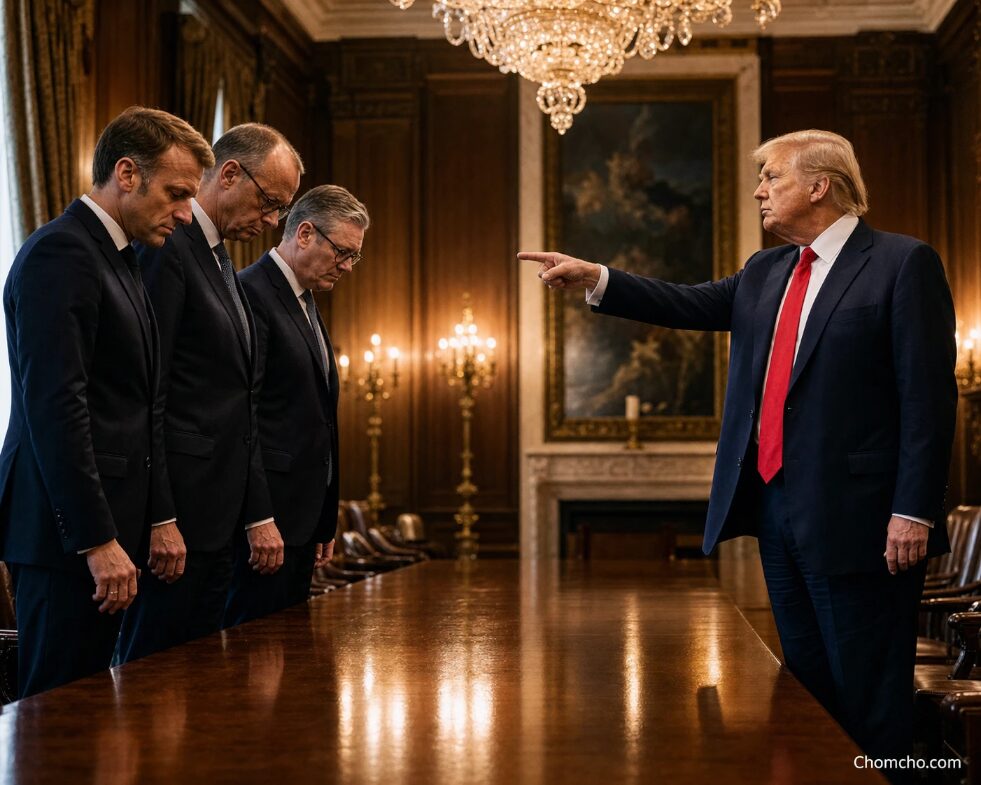
The G7 summit in Evian captured the contradiction in a single image.
Chancellor Merz walked over to @realDonaldTrump and handed him a custom German World Cup jersey with “Trump 47” on the back.
Macron gifted all seven leaders personalized road bikes from a French manufacturer. Meloni laughed warmly across the table.
These are the gestures of leaders who understand that the man they spent months lecturing has just reshaped the Middle East without them, and that warmth may now be the only currency they have left.
Trump said at the height of the conflict that he would remember the UK’s lack of support. He is not known for forgetting.
What this signals about Europe’s future role in world affairs
There was a time when France was the champion of liberty among nations, and when Britain ruled the seas and shaped the global order.
In June 2026, the European continent, even united under the European Union, is seeking relevance in a conflict it chose to observe from a distance.
Europe’s military capacity has atrophied over decades, a direct consequence of the American security umbrella that allowed European governments to fund generous social programs instead of defense budgets.
When the cost of that arrangement arrived in the form of a Middle East war threatening Europe’s energy supply, the bloc’s leaders responded not with resolve but with moral lectures, conditional naval pledges, and quietly negotiated bilateral fuel deals.
Mark Carney and Emmanuel Macron may dream of a Europe-led new world order built on institutions and norms rather than military power. But the MOU was negotiated through Pakistan and Qatar. The Strait of Hormuz was secured by American and Israeli force.
The 60-day nuclear talks ahead will be driven by Washington and Tehran.
If China continues to rise as a global superpower, which the ongoing US-China AI war has already previewed, the world of the coming decades may have even less room for European soft power than it does in June 2026.
A Holier than Thou posture can sustain a continent’s reputation for a season. It cannot substitute for courage, commitment, or the willingness to act when evil demands a response.
Europe is not yet irrelevant. But it is moving in that direction, one conditional naval mission, one bilateral energy deal, and one strongly worded communiqué at a time.