
This post is also available in:
 Português
  Español
  Français
  Deutsch
  Italiano
  Русский
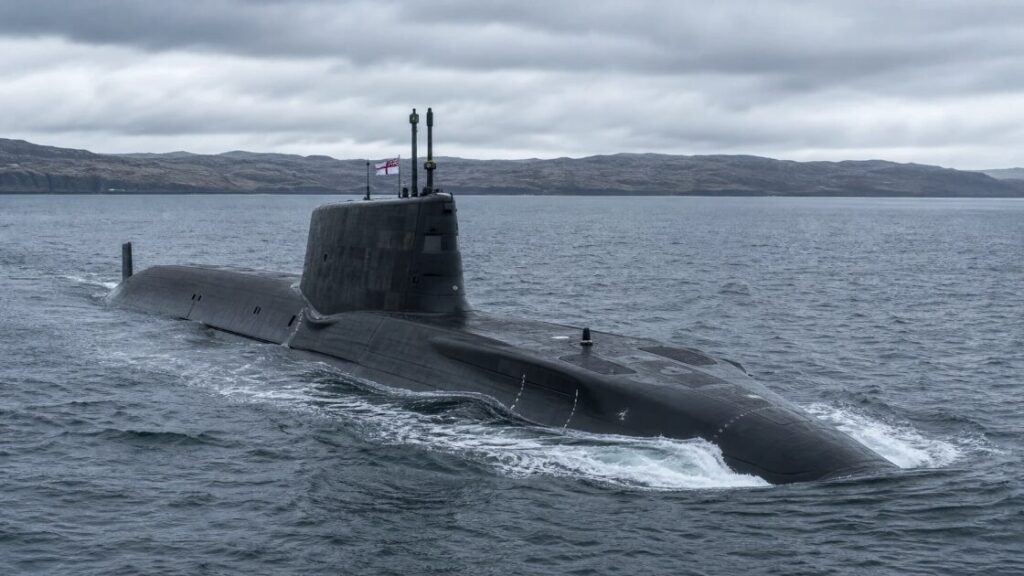
UK submarine crisis: Britain’s Royal Navy has no deployable attack submarines
Here is a military fact that should be making headlines everywhere but is not.
Right now, the United Kingdom has zero deployable nuclear attack submarines.
Not even one.
The entire Astute-class fleet, all five operational boats, is sitting in port undergoing maintenance.
A sixth, HMS Agamemnon, was recently commissioned but is not yet ready for deployment. A seventh, HMS Achilles, is still under construction at the BAE Systems shipyard in Barrow-in-Furness.
Britain is one of the five permanent members of the UN Security Council. It is America’s closest ally. It is a nuclear power. And right now it cannot put a single hunter-killer submarine to sea.
Former nuclear submarine captain Commander Ryan Ramsey called it “a serious wake-up call.”
Former First Sea Lord Admiral Alan West, the former head of the Royal Navy, was even blunter. He told reporters the fleet has suffered from “shockingly low availability” rates, with budget cuts and a “huge failure” in personnel management making things steadily worse.
He then added: “The UK is no longer capable of managing a nuclear submarine program. Performance across all aspects of the program continues to get worse in every dimension. This is an unprecedented situation in the nuclear submarine age. It is a catastrophic failure of succession and leadership planning.”
What is the difference between the two types of submarines?
To understand why this matters, a brief explanation helps.
Britain operates two types of nuclear submarines.
The Vanguard-class submarines are ballistic missile submarines. They carry Trident nuclear warheads and maintain Britain’s strategic nuclear deterrent through continuous patrols at sea.
They are still operational. Britain still has its nuclear deterrent.
The Astute-class submarines are nuclear attack submarines. They are the hunter-killers.
Their job is to track and destroy enemy submarines, escort aircraft carriers, monitor undersea cables and pipelines against sabotage, launch Tomahawk cruise missiles against land targets, and deploy special forces.
They are the working backbone of the Royal Navy.
Every single one of them is currently unavailable.
When the Iran crisis escalated in 2026, Britain considered deploying a carrier strike group to the Mediterranean.
It could not proceed.
No Astute submarines were available to escort the carrier. That is how consequential this UK submarine crisis has become.
How did this happen?
The causes are depressingly familiar to anyone who has followed European defense decline.
Decades of budget cuts left British shipyards understaffed and underequipped.
Dry dock capacity at Devonport and Faslane is insufficient to work on multiple submarines simultaneously.
The Royal Navy was forced to prioritize the Vanguard deterrent submarines, leaving Astute boats sitting in maintenance queues for one to two years at a time.
Subcontractors went bankrupt. Tooling became obsolete. Skilled engineers retired and were never replaced.
A naval source told the Mail recently that “a lack of investment for decades in providing the back-up infrastructure to keep them safe” caused the crisis.
The Submarine Maintenance Recovery Plan was ordered by First Sea Lord General Sir Gwyn Jenkins on January 15, 2026, with a goal of returning at least three Astute submarines to readiness by the end of 2026.
This is not the first time this grounding of attack submarines has happened. In 2023 all available British nuclear attack submarines were confined to port simultaneously.
Britain acknowledged the problem, promised to fix it, and then did not fix it.
The 2026 crisis is the 2023 crisis repeating itself because nobody learned anything.
The same week the submarine crisis broke, Britain’s flagship aircraft carrier HMS Prince of Wales, worth 3,500 million pounds, broke down again and was forced into port in Norway for repairs.
The carrier that was supposed to project British power across the Mediterranean and Indo-Pacific is in a Norwegian repair yard.
Industrial capacity is the real lesson — and it goes back to World War II
This UK submarine crisis is not just a maintenance problem. It is an industrial capacity problem. And that lesson goes back much further than people realize.
America’s industrial capacity was the decisive factor in World War II.
Between 1941 and 1945, the United States produced 300,000 aircraft, 100,000 tanks, 124,000 ships, 41,000 million rounds of ammunition, and 2,000,000 military trucks.
In 1944 alone, America built more planes than Japan produced from 1939 to 1945 combined. America launched more vessels in 1941 than Japan built during the entire war.
The Ford Motor Company was building a B-24 Liberator bomber every 63 minutes at its Willow Run plant in Michigan. Chrysler made tank fuselages. General Motors made aircraft engines, guns, and tanks.
President Roosevelt called it “the Arsenal of Democracy.” The economic historians are clear: the Axis powers were not defeated by superior tactics alone. They were out-produced.
That lesson applies directly in June 2026.
The Ukraine war has already proven that wars of attrition are decided by industrial capacity and the ability to replace losses.
China’s shipbuilding capacity is roughly 200 times greater than America’s. And Britain, the country that once ruled the seas, cannot maintain six submarines at the same time.
We wrote in a recent article about modern war infrastructure that undersea cables carry 97% of global internet traffic.
China has reportedly developed deep-sea cable-cutting devices capable of operating at 4,000 meters depth.
Protecting those cables is one of the primary missions of nuclear attack submarines. Britain currently has zero available to do it.
Europe’s promises vs. Europe’s reality
France and Germany have been making grand defense announcements for years.
In 2026, France and Germany’s $116,000 million joint sixth-generation fighter jet program, the Future Combat Air System (FCAS), was officially cancelled.
The two countries could not agree on who would lead the project.
Dassault insisted on industrial leadership. Germany considered going its own way. After nearly a decade of arguments, the program collapsed. The EU Defense Commissioner called it “a failure.”
The Franco-German Main Ground Combat System, a next-generation tank program, is a decade behind schedule and also appears headed for cancellation.
Germany operates six submarines. They are diesel-electric, not nuclear. They are capable but designed for the Baltic Sea, not blue-water global operations.
France operates nuclear attack submarines and is actually doing better than Britain, with its newer Suffren-class Barracuda submarines entering service.
But France is also the country promising Armenia defense partnerships and handing out weapons commitments like business cards while struggling to field its own carrier group reliably.
Trump has been warning European NATO members about defense spending since his first term.
At a 2018 NATO summit, German leaders were openly caught on camera laughing when Trump said Germany needed to spend more on defense.
They are not laughing now.
The America First lesson
The UK submarine crisis carries a direct message for Washington.
America must not outsource its national security to allies who cannot manage their own.
The special relationship with Britain is real and valuable. But alliance credibility depends on operational reality, not press releases.
America’s own submarine industrial base needs urgent attention.
Australia is waiting for nuclear submarines under the AUKUS agreement. But both Britain and the United States are struggling to build and maintain submarines fast enough.
If China ever moves on Taiwan, the Indo-Pacific deterrence that depends on submarine superiority will be tested.
The lesson of World War II is clear. The side that out-produces wins.
America built an Arsenal of Democracy in four years because civilian factories were ready and the industrial workforce existed.
Britain spent decades cutting that industrial base. The result is six submarines on paper and zero at sea.
America must not make the same mistake.
Defense industrial capacity is not a luxury. It is national survival.