
This post is also available in:
 Português
  Español
  Français
  Deutsch
  Italiano
  Русский
UK China reset: why the whole world is courting Beijing
It is the latest sign of a global realignment that Washington cannot afford to ignore.
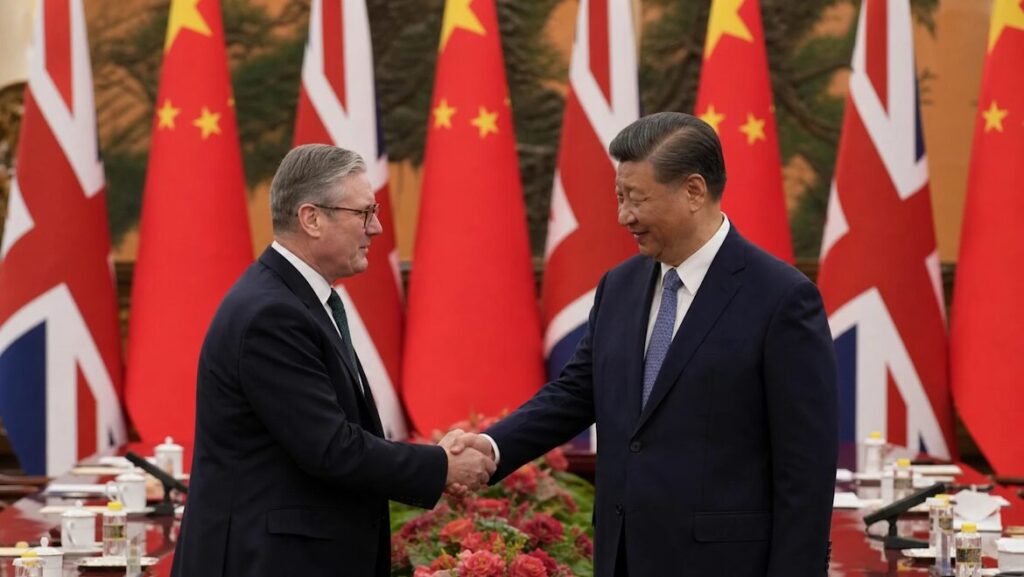
On June 1, 2026, UK Foreign Secretary Yvette Cooper landed in Beijing for a three-day diplomatic mission — the second senior UK visit to China in five months.
Her delegation carried burner phones the entire trip, over espionage concerns. They went anyway.
Cooper met Foreign Minister Wang Yi and Vice President Han Zheng, describing the talks as conducted with “candour and respect.”
This follows Prime Minister Keir Starmer’s January 2026 visit to China — the first by a British Prime Minister since Theresa May in 2018.
Starmer called the previous period of relations an “ice age.” The UK China reset is now officially underway. But Britain is far from alone.
The Western middle powers all went to Beijing — and the timing is not a coincidence
The pattern is impossible to ignore.
French President Emmanuel Macron visited China in December 2025 — his fourth trip since taking office.
After his 2023 China visit, Macron said Europe must avoid becoming America’s “vassals” and called for European “strategic autonomy” — a statement that drew sharp condemnation from Washington and US-aligned European capitals.
Spanish Prime Minister Pedro Sanchez visited China in April 2026 — his fourth trip in four years. Spain’s trade deficit with China nearly doubled to $50,000 million in 2025, yet Sanchez keeps going back.
The Chinese ambassador to Spain put it bluntly: “Spain is more reasonable in dealing with China. It has its own judgment, its own interests.”
Canadian Prime Minister Mark Carney flew to Beijing in January 2026 — the first Canadian leader to visit China since 2017 — pledging to “double non-US trade over the next 10 years.”
And EU Commission President Ursula von der Leyen attended the 25th EU-China Summit in Beijing in July 2025.
What is driving this? Simple. Trump’s tariffs and China’s economic gravity are pushing middle-sized Western powers toward Beijing — not because they trust China, but because they fear being left out of the world’s second largest economy.
As one Canadian official put it plainly: “The global economic environment has fundamentally changed.”
The developing world is doing the same — and China is using its checkbook
India and Brazil tell a similar story, from a different angle.
India, despite its border rivalry with China and ongoing territorial disputes, has quietly resumed high-level diplomatic and trade engagement with Beijing.
The president of Brazil, Luiz Inacio Lula da Silva, already cozy with Cuba and Venezuela, has deepened BRICS cooperation with China and welcomed Chinese investment into Brazilian infrastructure and rare earth mining.
South Africa, a BRICS founding member, has moved steadily into Beijing’s orbit.
Across the Global South, China’s Belt and Road Initiative has become the dominant infrastructure financing tool — funding ports, highways, railways, and power plants that Western institutions will not touch.
Nations that cannot get loans from the IMF or World Bank on reasonable terms get them from Beijing — with strings attached that Washington is only beginning to understand.
The UK China reset is the Western version of the same dynamic. Dress it up in diplomatic language, but the logic is identical.
Where the US stands — and why Rubio’s warning matters
Secretary of State Marco Rubio told the Senate Foreign Relations Committee just days ago: “Competition with China now touches nearly every aspect of American foreign policy.”
He is right. And China’s economic numbers explain why the world keeps courting Beijing.
China’s Purchasing Power Parity Gross Domestic Product — the measure of an economy’s real output adjusted for cost of living — is already larger than America’s.
In nominal GDP, the standard measure of economic size in market prices, the United States remains the world’s largest economy. But the gap is closing.
This is precisely why Trump’s America First agenda matters.
A stronger, richer, more competitive America is the only answer to China’s rising gravitational pull.
Nations do not court weakness. They court power. Every leader flying to Beijing is implicitly betting that China will be tomorrow’s dominant superpower.
Trump’s entire presidency is a bet in the opposite direction — that America can still outcompete, outproduce, and outlast.
The UK China reset is not just Britain’s problem.
It is a symptom of a world that is hedging its bets. America’s job is to make sure those bets are wrong.