
This post is also available in:
 Português
  Español
  Français
  Deutsch
  Italiano
  Русский
  Nederlands
  日本語
日本語  Polski
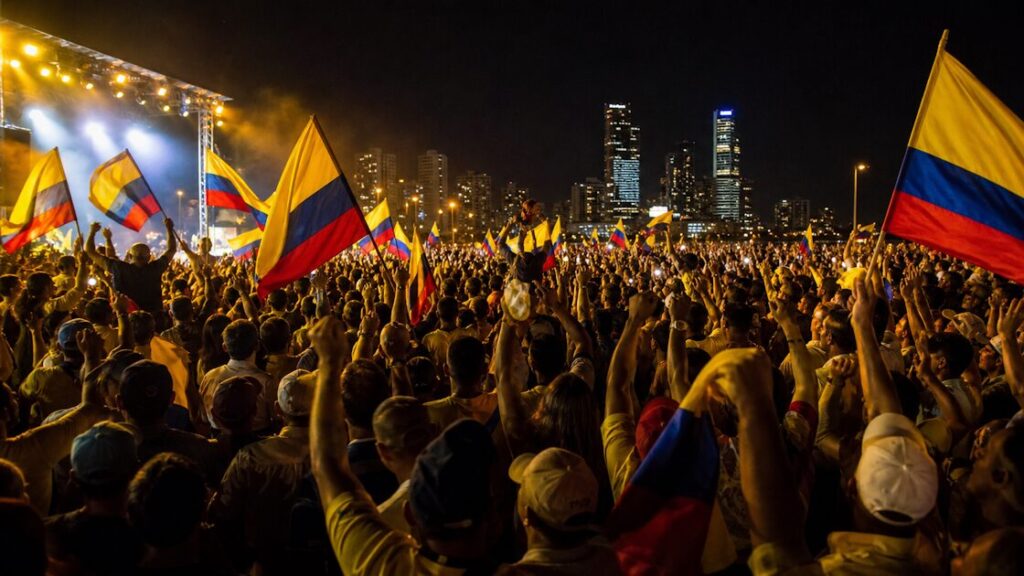
Colombia runoff election: De la Espriella shocks the Left
Colombia’s first round delivered a stunning result today, May 31, 2026.
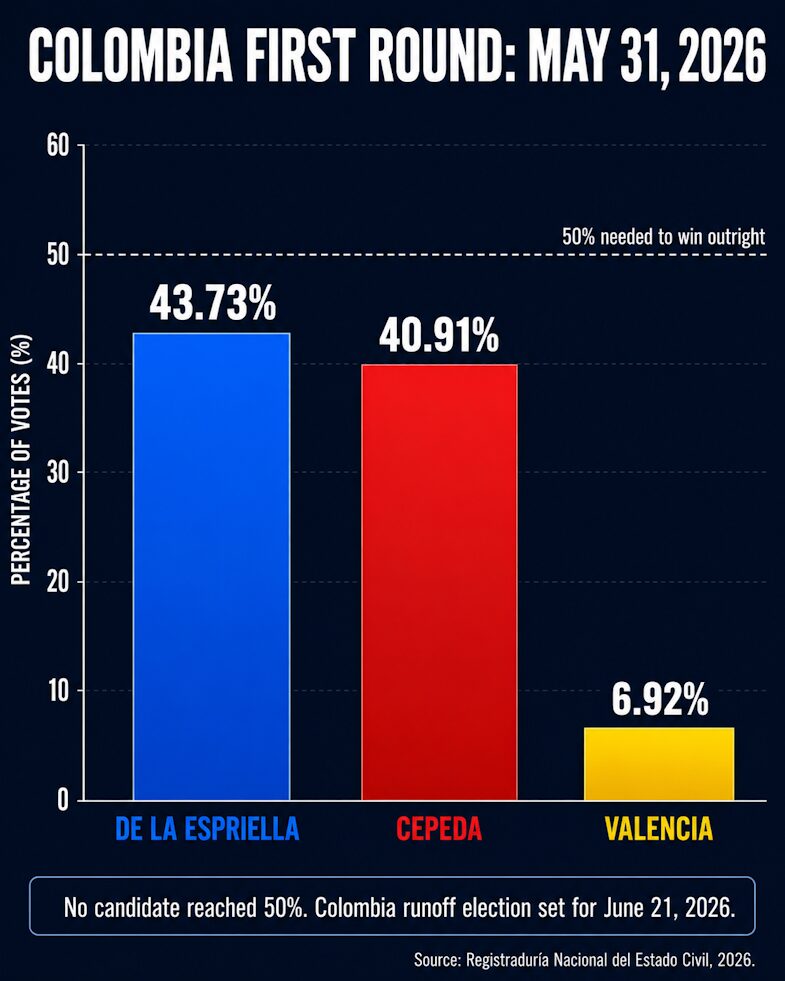
Abelardo de la Espriella crushed every polling expectation with 43.73% of the vote — nearly double what most analysts had predicted just weeks ago.
Leftist Senator Ivan Cepeda finished second with 40.91%.
Neither candidate reached the 50% threshold required to win outright under Colombia’s two-round presidential system.
The Colombia runoff election is now confirmed for June 21, 2026.
Within hours of the results, third-place finisher Paloma Valencia — who captured 6.92% running on the Democratic Center ticket — officially endorsed De la Espriella.
In a direct and unambiguous statement, Valencia declared: “I announce my support for Dr. Abelardo de la Espriella and I call on everyone to defeat Cepeda — so that the neo-communism that has taken hold of this country does not continue.”
Despite months of sharp tensions and personal attacks between her campaign and De la Espriella’s, Valencia made clear that stopping Cepeda and Petro’s political legacy was her absolute priority going into the June 21 runoff.
Translation: she is putting her 1,600,000 votes and the full weight of the center-right Uribista movement behind De la Espriella to stop what she openly calls neo-communism.
The right is now unified.
The math has shifted significantly in De la Espriella’s favor.
Two candidates, two very different Colombias
Ivan Cepeda, 63, is not a political newcomer pretending to be a moderate.
He is a career leftist senator with decades of documented alignment with Colombia’s radical left.
His political biography includes active membership in the Communist Party, the Patriotic Union, and the Democratic Alliance M-19 — the political arm of a former guerrilla movement.
He is the hand-picked continuity candidate of outgoing President Gustavo Petro, whose Pacto Histórico coalition has governed Colombia since 2022 with a combination of radical wealth redistribution, diplomatic confrontation with Washington, and open sympathy for Venezuela’s Nicolas Maduro.
In a CNN interview, Cepeda stated he would maintain Petro’s foreign policy line on both Venezuela and the United States — warning that American military engagement in the region risks turning Latin America into “a war zone.”
His economic priority is eradicating monetary poverty through what he calls a more equitable distribution of production — a formula that sounds reasonable until you read the fine print.
He also expressed openness to a National Constituent Assembly to rewrite Colombia’s constitution if a “broad consensus” exists.
In Latin American leftist politics, that phrase is not a safeguard. It is a playbook.
Venezuela, Bolivia, and Ecuador all began their radical transformations the same way — a constituent assembly that dismantled institutional checks and concentrated power.
Cepeda’s critics also noted his proposal to abolish the Council of State, one of Colombia’s highest judicial courts, which opponents called a direct threat to institutional checks and balances.
And in March 2026, he sparked national outrage by labeling Antioquia — Colombia’s most productive and entrepreneurial department — the “cradle of parapolitics, the narco-economy, and state terrorism.”
The backlash was fierce and immediate across the entire region.
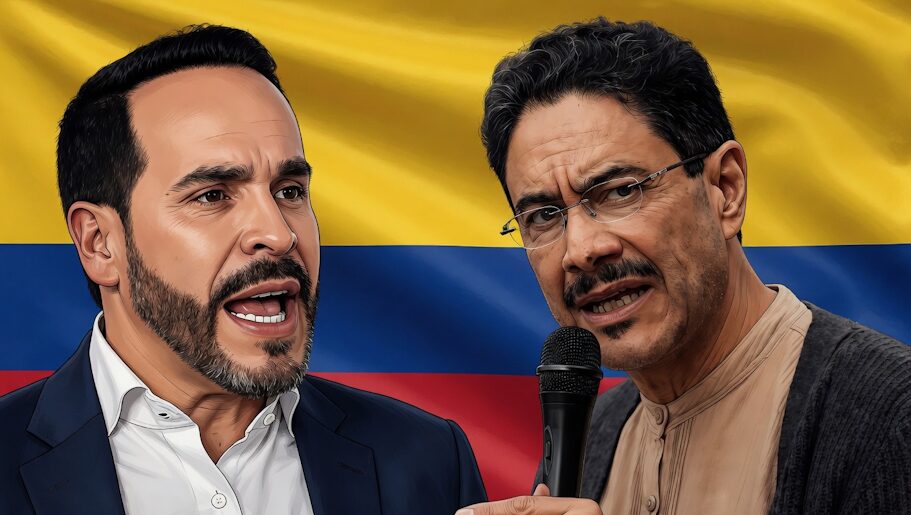
Abelardo de la Espriella, 47, is a lawyer and political outsider who has never held elected office.
That outsider status is precisely his strength.
In a country exhausted by four years of Petro’s radical governance, economic uncertainty, and deteriorating public security, De la Espriella arrived as something Colombia rarely produces — a man with genuine popular energy who is not a product of the traditional political establishment.
He built his national profile almost entirely through social media, direct engagement with ordinary Colombians, and a message that resonated far beyond his original base. Tonight’s first-round result — nearly double what pollsters predicted — is the clearest possible proof that his appeal is real and broad.
De la Espriella models himself explicitly after El Salvador’s Nayib Bukele and Argentina’s Javier Milei — promising 10 mega-prisons, aggressive anti-cartel enforcement, lower taxes, expanded oil exploration, and strong alignment with both Trump and Israel.
His economic platform is built on shrinking the state by 40%, cutting corporate taxes to attract foreign investment, and reopening Colombia’s hydrocarbon sector after years of Petro’s anti-fossil fuel hostility.
On security, he has pledged to join Trump’s Americas Counter Cartel initiative — a direct reversal of Petro’s confrontational posture toward Washington.
On Israel, he has explicitly committed to stronger bilateral security ties — another sharp break from Petro, who expelled the Israeli ambassador and became one of the most aggressively anti-Israel heads of state in the Western Hemisphere.
His critics note that he previously served as defense attorney for Alex Saab — the Venezuelan businessman and alleged Maduro front man sanctioned by the U.S. Treasury — and that his Bukele-style security proposals have raised human rights questions in some quarters. He is not without controversy.
But his controversies are about methods. Cepeda’s controversies are about ideology. One is a debate about how to fight crime. The other is a debate about whether Colombia remains a free society at all.
Colombia runoff election: what each candidate has promised
The contrast between the two men sharpens further when you examine their specific policy commitments.
On security: De la Espriella has promised to join Trump’s Americas Counter Cartel initiative and build Bukele-style mega-prisons to house Colombia’s most dangerous criminals.
Cepeda has historically defended peace negotiations with armed groups — though in a stunning rhetorical shift at his closing Bogotá rally, he warned the ELN, FARC dissidents, and the Clan del Golfo: “I am going to hunt you down like rats.”
Political analysts immediately noted the radical departure from his usual measured tone — widely interpreted as a last-minute attempt to appeal to security-exhausted voters before the first round.
Cepeda would represent a continuation of Petro’s foreign policy — and Petro has been one of the most aggressively anti-Israel heads of state in the Western Hemisphere, repeatedly comparing Israel’s military operations to genocide and expelling the Israeli ambassador.
On Venezuela: De la Espriella would reset relations toward Washington’s position. Cepeda would maintain Petro’s alignment with Maduro.
Petro’s electoral legacy — and Colombia’s bill
Petro spent his final year engineering the most favorable possible electoral terrain for Cepeda.
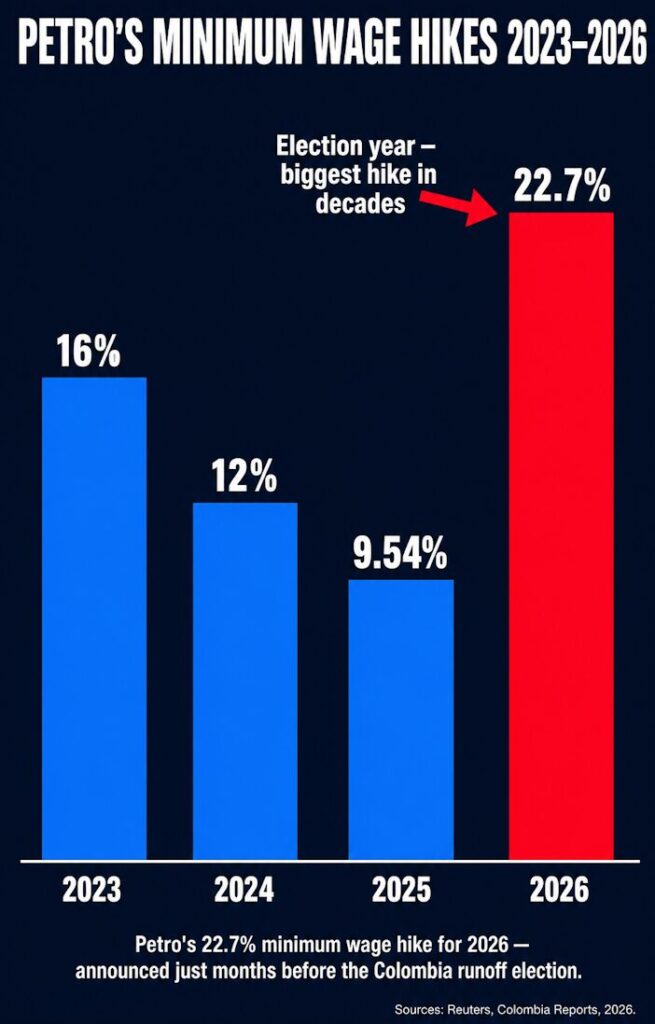
He decreed a 22.7% minimum wage increase for 2026 — the largest in decades and more than double the previous year’s 9.54% increase — over the fierce objections of business groups who warned it would fuel inflation and raise interest rates.
Colombian swap rates soared immediately after the announcement as markets priced in the inflationary consequences.
He also reduced highway tolls in strategic right-leaning regions ahead of the vote — a transparent electoral calculation dressed as social policy.
Colombia’s working class received real short-term benefits. The long-term economic bill will arrive regardless of who wins on June 21.
The Colombia runoff election is not simply a choice between two candidates. It is a choice between two entirely different futures — and the clock is already running.
The people of Colombia deserve security, sovereignty, and honest governance.