
This post is also available in:
 Português
 Español
 Français
 Deutsch
 Italiano
 Русский
Summary
Her approval has fallen from above 70 percent to 42.4 percent, but Takaichi's first year changed Japan's place in the world.
She did not invent a new foreign policy; Former prime ministers Shinzo Abe and Fumio Kishida began the turn from pacifism to deterrence. She continues the same policy at full speed.
Taiwan, stated openly. On November 7, 2025, she told parliament that a Chinese attack on Taiwan could be a "survival-threatening situation" for Japan, the legal term that lets Japanese forces fight alongside an ally.
Chinese President Xi Jinping calls Taiwan "the first red line that must not be crossed," and China responded step by step: a post by a Chinese consul general saying "cut off that dirty neck", a travel advisory, a seafood ban, radar locked on Japanese jets, exports of heavy rare earths cut to zero, 40 Japanese firms on export-control lists. She refused to retract.
The money and the weapons. Japan reached 2 percent of GDP on defense in fiscal 2025, two years early.
On April 21, 2026, her cabinet removed the five categories that had limited arms exports since 2014. Japan can now sell warships, missiles and fighters.
Allies beyond the United States. A deal for 11 Mogami-class frigates for Australia, intelligence talks with the Philippines, security cooperation with South Korea.
The logic: make it impossible for China to isolate one country at a time.
Golden age, with a limit. U.S. President Donald Trump visited Tokyo one week into her term, a summit took place in Washington in March 2026, and Japan pledged to invest 550,000 million dollars in the United States. But Japan will not write the 3.5 percent of GDP target requested by the United States into its new strategy.
Japan is moving from strategic dependence toward strategic responsibility.
A credible deterrent against a Taiwan attack? Not yet. But every government in the region now calculates differently.
While France lists the MAGA (Make America Great Again) movement beside Russia and China, Japan builds, pays and stands with the United States.
A strong Japan is a safer Pacific.
One year in office
On October 21, 2026, Sanae Takaichi completes her first year as Japan’s prime minister, the first woman to hold the office.
She arrived with approval ratings above 70 percent, and in February 2026 she led her Liberal Democratic Party (LDP) to the largest victory in the history of Japan’s lower house, at least 316 seats and a two-thirds majority.
However, her early popularity has faded: a poll by the Jiji Press news agency in mid-October 2026 put her approval at 42.4 percent, the lowest since she took office, and a poll by the Kyodo News agency found her below 50 percent for the first time in that survey.
Takaichi’s first year did not invent a new Japanese foreign policy. The turn from postwar pacifism toward deterrence began under Shinzo Abe and continued under Fumio Kishida.
What changed is speed, emphasis and the willingness to say out loud what her predecessors only implied.
The clearest example came less than three weeks after she took office, and the statement was about Taiwan.
Taiwan said out loud
On November 7, 2025, answering a question in parliament about a Chinese naval blockade of Taiwan, Takaichi said: “If warships are used and other armed actions are involved, I believe this could constitute a survival-threatening situation.”
The phrase is a legal term from Abe’s 2015 security laws: a situation in which an attack on a close partner threatens Japan’s own survival and allows the Self-Defense Forces to use force alongside an ally.
Earlier prime ministers had avoided saying whether Taiwan qualified. Prime Minister Takaichi said Taiwan did qualify.
To understand Beijing’s fury, remember what Chinese President Xi Jinping told U.S. President Joe Biden in Bali in November 2022: “The Taiwan question is at the very core of China’s core interests, the bedrock of the political foundation of China-US relations, and the first red line that must not be crossed.”
A Japanese prime minister had just crossed that line.
The retaliation came in order.
On November 8, China’s consul general in Osaka, Xue Jian, posted on X that China had “no choice but to cut off that dirty neck that has lunged at us without a moment’s hesitation,” and Xue asked: “Are you ready?”
The post was deleted after Japan protested, and Beijing called it a personal opinion.
On November 14, China told its citizens to avoid traveling to Japan. On November 19, China halted imports of Japanese seafood. On November 22, Chinese Foreign Minister Wang Yi said Takaichi had crossed a “red line.”
On December 6 and 7, Japan said jets from the Chinese carrier Liaoning locked fire-control radar on Japanese F-15 fighters near the Miyako Strait; the Chinese government denied this.
Also, on January 6, 2026, China banned exports of dual-use goods to the Japanese military.
Chinese shipments of two heavy rare earths, terbium and dysprosium, fell to zero from November, and in February and June 2026, the Chinese government placed 40 Japanese companies on export-control lists and 40 more on a watch list; the names included Mitsubishi, IHI and Subaru.
Chinese visitors to Japan also fell by about 60 percent in January 2026.
Prime Minister Takaichi refused to retract her statement. She said she would avoid discussing specific cases in the future, and nothing more.
Eleven months later, the dispute is still open.
She says she will attend the Asia-Pacific Economic Cooperation (APEC) summit in Shenzhen, China, in mid-November 2026 if parliament allows her to travel, which would put her in the same room as Xi for the first time since the freeze.
The money and the weapons
The spending changed faster than the political statements.
Kishida had promised to lift defense spending to 2 percent of GDP by fiscal 2027.
In November 2025, Takaichi’s cabinet approved a supplementary budget of 1.1 trillion yen, about 7,000 million dollars.
Added to everything Japan counts as defense-related spending, including the coast guard and the relocation of U.S. forces, this budget pushed the fiscal 2025 total to about 11 trillion yen, about 70,000 million dollars, past the 2 percent mark two years early, by the government’s own count.
“We have already achieved the 2 percent of GDP level,” Japanese Defense Minister Shinjiro Koizumi said.
The Defense Ministry’s own budget for fiscal 2026, approved in December 2025, exceeds 9 trillion yen, about 58,000 million dollars, a record and a 9.4 percent increase, before any supplementary budget or related spending is added during the year.
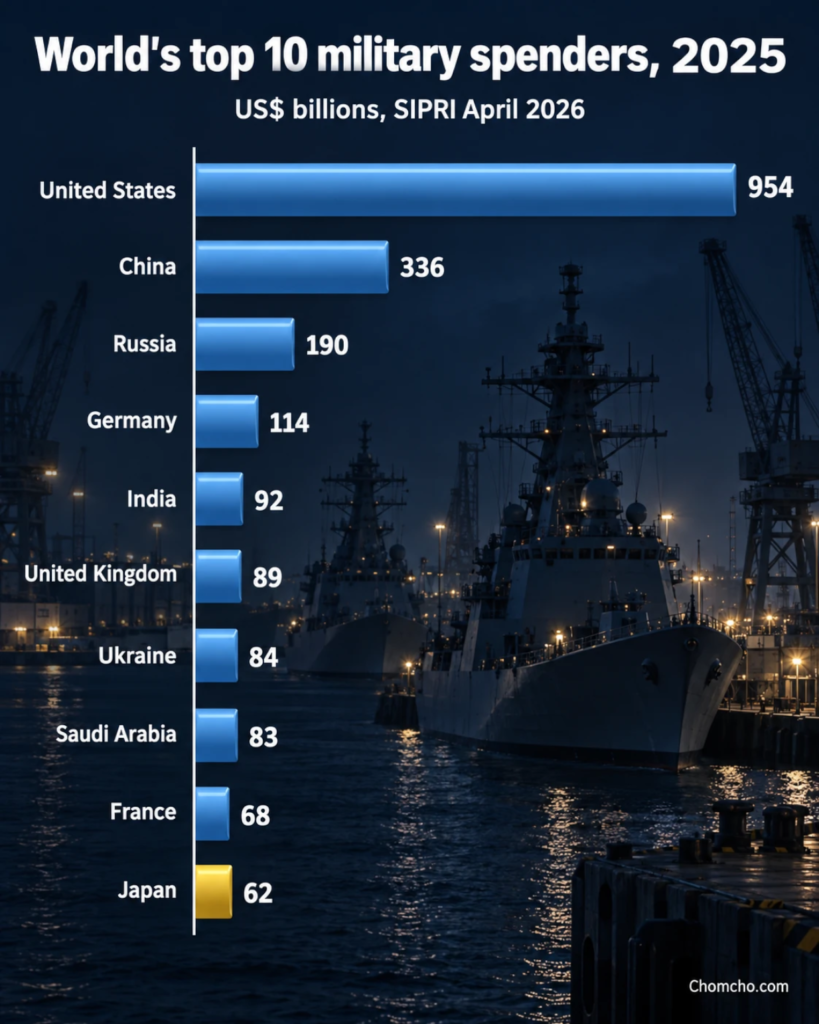
A note of caution on the ranking. Some reports describe Japan as becoming the world’s third-largest military spender.
The Stockholm International Peace Research Institute puts Japan tenth in 2025, at 62,200 million dollars, behind countries such as Germany, India, Ukraine and France, and far behind the United States at 954,000 million and China at 336,000 million.
Japan is rising in the ranking, but it has not reached that position yet.
The weapons changed more than the money. Since 1976, Japan had kept a near-total ban on arms exports, a self-imposed rule, not a constitutional one.
Abe eased it in 2014, but exports of finished equipment stayed limited to five harmless categories: rescue, transport, warning, surveillance and minesweeping.
Kishida made two exceptions, allowing Patriot missiles built under American license to be sold back to the United States in 2023 and the future export of a new fighter jet in 2024.
On April 21, 2026, Takaichi’s cabinet removed the five categories altogether. “With this amendment, transfers of all defense equipment will in principle become possible,” she wrote on X, to countries that pledge to use the equipment in line with the United Nations Charter.
In plain words, Japan can now sell warships, missiles and fighter jets.
Prime Minister Takaichi’s chief cabinet secretary, Minoru Kihara, explained the change in one sentence: “Today, no nation can safeguard its own peace and security by itself alone.”
The Chinese government voiced “serious concern.” The Chinese Foreign Ministry spokesman, Lin Jian, had already complained in December that Japan “noticeably accelerated its pace of military buildup and expansion.”
For once, Beijing’s description was accurate.
Allies beyond Washington
The first customer was Australia.
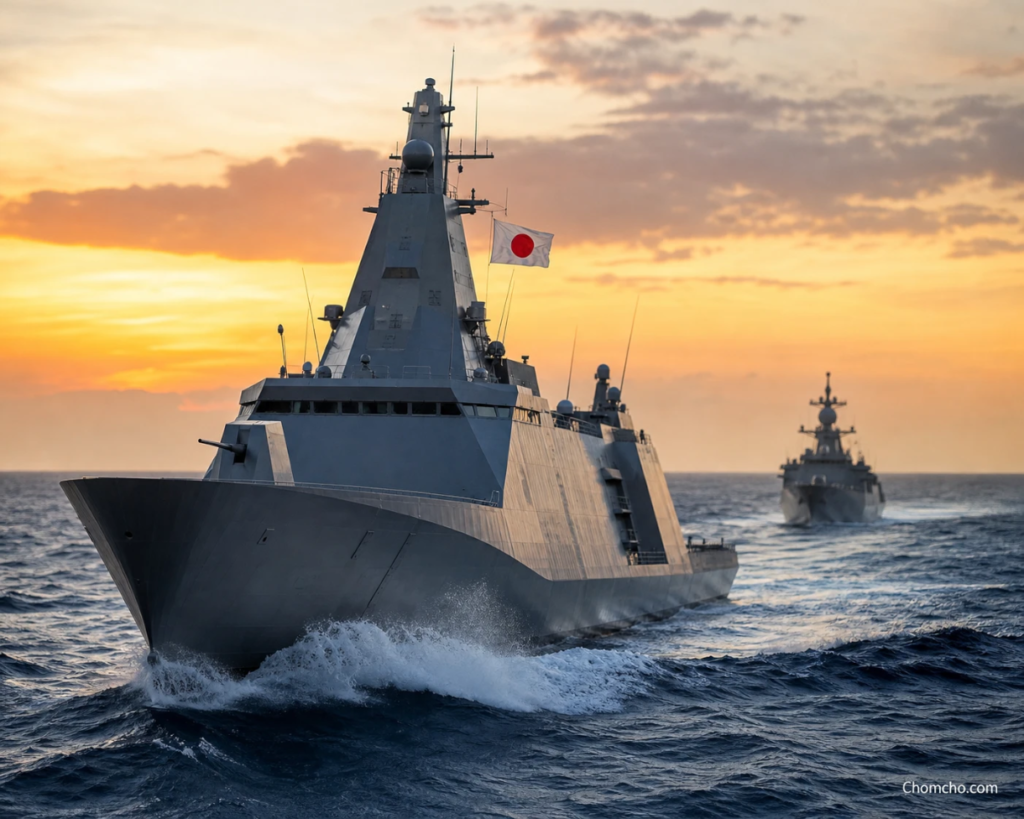
On April 18, 2026, aboard the Japanese frigate Kumano docked in Melbourne, the two governments signed the “Mogami Memorandum”: 11 upgraded Mogami-class frigates for the Royal Australian Navy, a deal worth up to 20,000 million Australian dollars, about 14,400 million U.S. dollars.
The first three will be built in Nagasaki for delivery by the end of 2029, and the other eight in Western Australia.
Chomcho reported on the start of this deal in August 2026. It is the largest military export in Japan’s history, and in 2016 Japan lost a submarine contract in the same country.
The Philippines came next. In May 2026, Japan and the Philippines agreed to begin talks on an intelligence-sharing agreement, and Japanese forces test-fired a missile during Balikatan, the annual U.S.-Philippine military exercise, in the Philippines, which drew Chinese criticism.
South Korea, the most difficult neighbor, was also included: Prime Minister Takaichi hosted South Korean President Lee Jae-myung in her home prefecture of Nara in January 2026, where the two agreed on security cooperation involving the United States and on regular visits between the two leaders.
The logic is simple. Beijing’s method is to isolate one country at a time and punish it, as it is punishing Japan now.
A network of agreements among Japan, Australia, the Philippines and South Korea makes that harder. It also gives Tokyo options if Washington’s attention ever shifts elsewhere.
Golden age, with a limit
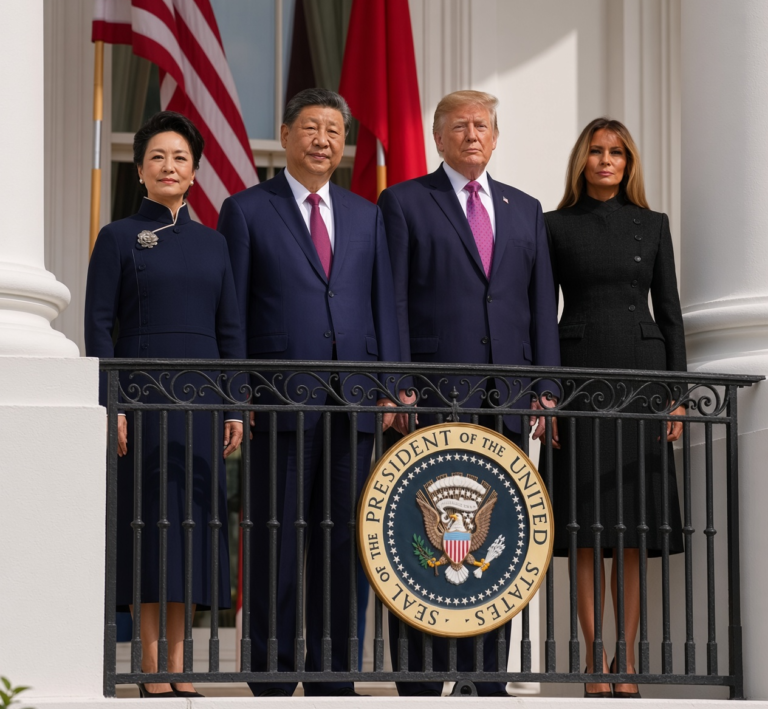
One week into her term, Prime Minister Takaichi received U.S. President Donald Trump.
On October 28, 2025, at Akasaka Palace in Tokyo, the two signed agreements on trade, critical minerals, nuclear technology and rare earths, and at the Yokosuka naval base she promised a “golden age” of the alliance.
She visited Washington on March 19, 2026.
Behind the ceremony stands the July 2025 trade deal: a 15 percent tariff on Japanese goods in exchange for a Japanese pledge to invest 550,000 million dollars in the United States.
There is a limit, and it should be stated honestly.
The Trump administration has pressed Tokyo, repeatedly and in private, to raise defense spending to 3.5 percent of GDP, calling it a global standard for allies.
On October 16, 2026, the Asahi Shimbun newspaper reported that Japan will stop short of writing that number into the national security strategy Japan is revising in 2026.
Tokyo will promise a large five-year increase instead and hopes that visible capability will satisfy Washington.
Japan wants the American guarantee, and it also wants to decide its own numbers.
Economic security ties the pieces together.
When China cut off heavy rare earths, Japan turned to the United States and Australia for supply chains, exactly the kind of agreements Trump and Takaichi signed in Tokyo.
China’s coercion did not bend Japan; it taught Japan who its friends are.
Three developments that matter most
Beyond the headlines, three things remain.
First, Japan is becoming a capable military power: 2 percent of GDP reached two years early, the export ban gone, warships sold to a partner.
Second, Japan is building a regional security network and no longer waits for Washington to organize the response to China.
Third, Japan is testing the limits of its postwar identity.
Takaichi wants the constitution revised to recognize the Self-Defense Forces explicitly, and she now has a two-thirds majority in the lower house, one of the conditions revision requires, though she has taken no concrete step.
Her government may also review the three non-nuclear principles, which say Japan will not possess, produce or allow nuclear weapons into the country.
A Japanese bomb is not on the table; the first two principles cannot be changed in the country of Hiroshima and Nagasaki.
The one in play is the third, which bars American nuclear-armed ships and aircraft from Japanese ports and bases.
Takaichi has written that it is unrealistic, and Defense Minister Koizumi said in July 2026 that the nuclear debate should no longer be taboo, though in parliament she said, “we are firmly maintaining the principles.”
Credit where it belongs. The 2 percent goal, the five-year buildup and the first easing of export rules came from Abe and Kishida.
Takaichi personally added the Taiwan statement, the two-year acceleration, the end of the export categories and the frigate deal.
Abe started this policy; Prime Minister Takaichi is advancing it at full speed.
From dependence to responsibility
The deeper story is that Japan is moving from strategic dependence toward strategic responsibility.
For eighty years Tokyo bought protection with bases and money and let Washington do the deterring. That era is ending.
Is Japan becoming a credible deterrent against a Chinese attack on Taiwan?
Not yet. Its arsenal is growing, but a deterrent needs munitions stockpiles, trained crews and the political will to fire, and the last of these has never been tested since 1945.
What has changed is the calculation in every capital.
Beijing now knows a Taiwan war could mean Japan, not only the United States.
Taipei has a second friend with a navy. Manila and Canberra have a supplier and a partner. Seoul keeps talking to Tokyo about security despite the old wounds. Washington has an ally that pays and builds.
That is why Japan’s transformation may prove more consequential than Takaichi’s rhetoric.
The rhetoric gave the Chinese government an excuse for an angry reaction. The transformation will outlast her approval ratings and probably her government.
The ally America First wants
Compare two allies during the same week.
On October 13, France’s foreign minister placed the MAGA (Make America Great Again) community on a list of hostile foreign influences beside Russia, China and Iran.
On October 21, Japan’s prime minister marks a year of building a golden age with Trump, reaching 2 percent two years early and paying about 2,200 million dollars in a single supplementary budget to relocate American forces.
One ally lectures. The other arms.
U.S. Defense Secretary Pete Hegseth recognized this early. In Tokyo in March 2025, he called Japan an indispensable partner in deterring China and told his Japanese counterpart: “We share a warrior ethos that defines our forces.”
Peace through strength works when allies carry their share, and Japan carries more every year.
The 3.5 percent debate will continue, and Washington should keep pressing, but a partner that reaches 2 percent two years early has earned a respectful argument, not a lecture.
Takaichi’s first year shows what America First asks of an ally: pay your share, build your own strength, and stand with the United States when the red lines are drawn.
Scripture puts the posture in one verse: “Be on your guard; stand firm in the faith; be courageous; be strong” (1 Corinthians 16:13, NIV).
A strong Japan is a safer Pacific.