
This post is also available in:
 Português
 Español
 Français
 Deutsch
 Italiano
 Русский
 Nederlands
 日本語
 Polski
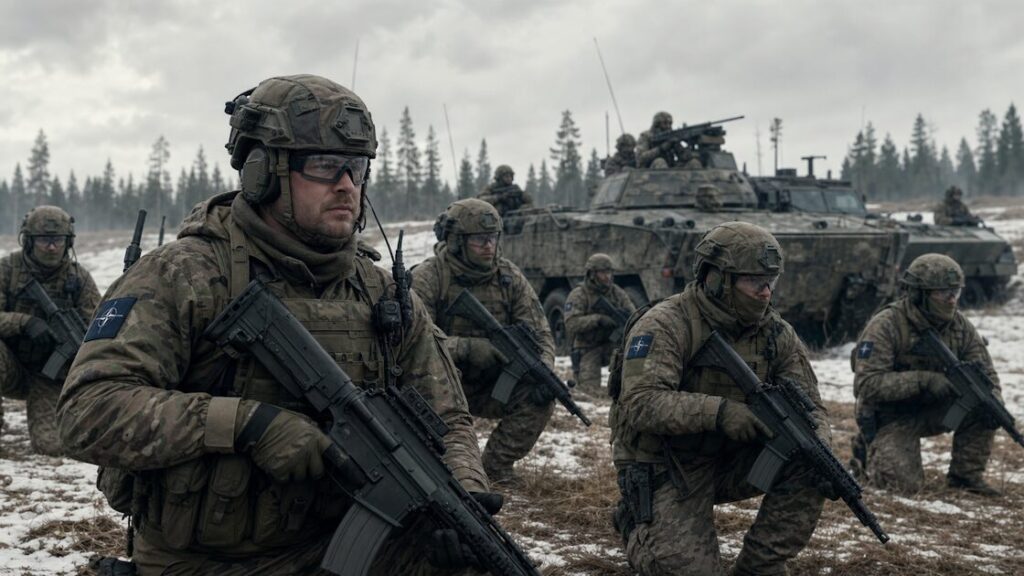
NATO eastern flank gets a dedicated defense — here is what it just changed
NATO is restructuring its eastern flank — and this is breaking news today, May 26, 2026.
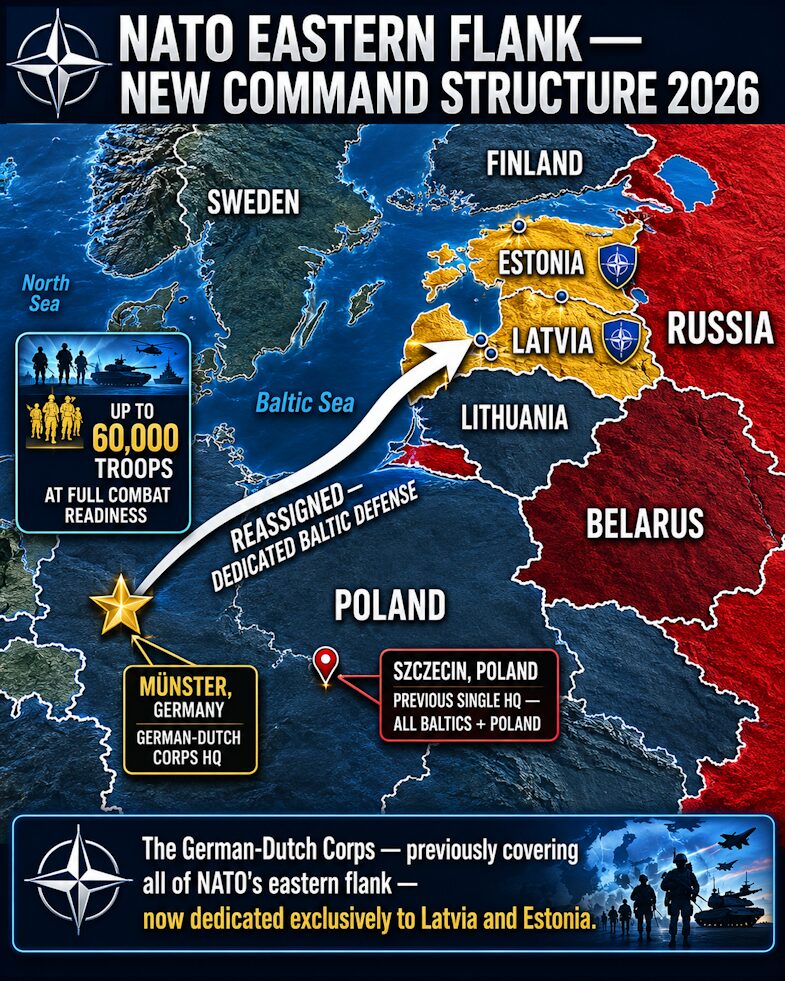
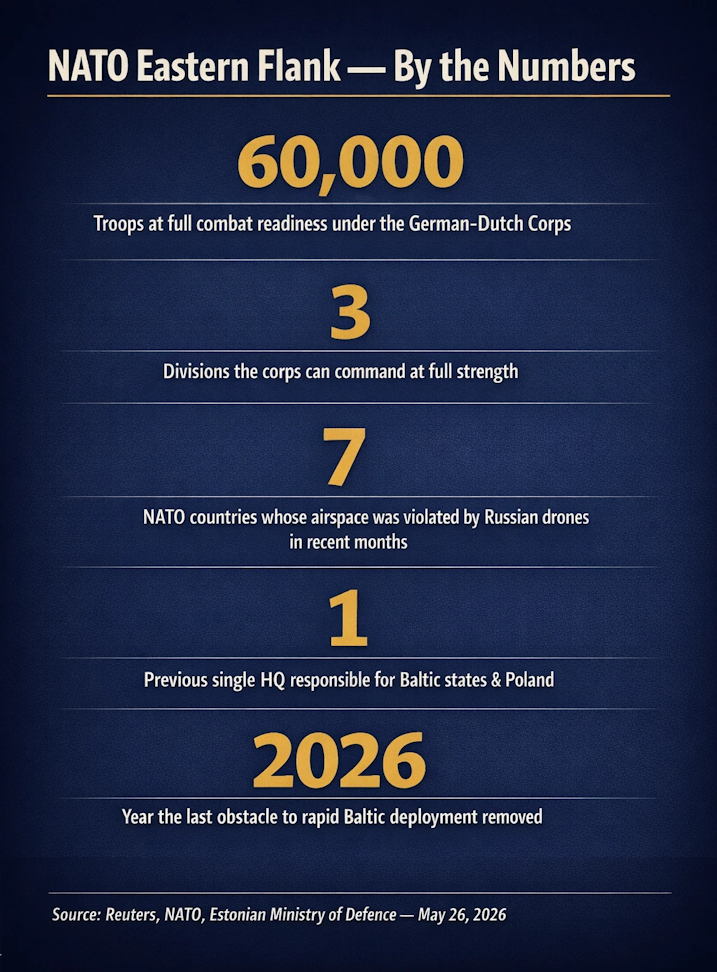
The German-Dutch Corps, currently headquartered in Münster, Germany, is being reassigned to take dedicated responsibility for the defense of Latvia and Estonia in the event of a conflict with Russia.
At full combat readiness, the corps can command three divisions — up to 60,000 troops — with long-range artillery, air defense, engineering, and medical support now fully assigned.
Until May 26, a single multinational headquarters in Szczecin, Poland was responsible for ALL three Baltic states plus northern Poland.
One command structure for four exposed NATO members.
Reuters, citing two sources familiar with the matter, confirmed that this agreement has “removed the last obstacle” to rapid deployment on NATO’s most vulnerable front.
That is a significant statement. The last obstacle is gone.
The Baltics — the most dangerous border in Europe right now
Latvia and Estonia share direct borders with Russia and Belarus. They are NATO’s most exposed members on the continent.
Russian drones have already violated the airspace of Estonia, Latvia, Lithuania, Finland, Norway, Poland, and Romania in recent months.
NATO launched Baltic Sentry in January 2025 following multiple incidents involving suspected Russian sabotage of critical undersea infrastructure in the Baltic Sea.
Estonian Defense Minister Hanno Pevkur said last year that the German-Dutch Corps deployment “is a fairly significant development” for the Estonian Defense Forces.
The Baltic states have been warning for years that a Russian blitzkrieg scenario would require hours — not days — to respond to.
European Commission President Ursula von der Leyen (@vonderleyen) arrived in Lithuania on May 26 — the same day this restructuring was announced — citing a series of Russian drone incidents in Baltic airspace as the formal reason.
The timing is not coincidental.
NATO eastern flank and what it means for US foreign policy
Here is the America First takeaway.
President Trump has publicly criticized European NATO members for not pulling their weight — specifically during the Iran war, when US naval and military assets were stretched thin across the Persian Gulf, the Strait of Hormuz, and the Indo-Pacific simultaneously.
Europe heard the message.
Germany and the Netherlands are now committing their own corps — their own troops, their own artillery, their own air defense — to the Baltic front.
That is burden sharing in action.
America cannot simultaneously fight Iran, deter China, suppress Somali piracy, and defend the Baltics alone.
This NATO eastern flank restructuring means one less front that depends entirely on Washington.
From an America First perspective, that is exactly the outcome this administration has demanded for years — and on May 26, Europe delivered.
In reply to: @KyivIndependent https://x.com/KyivIndependent/status/2059432199053595114?s=20