
This post is also available in:
 Português
  Español
  Français
  Deutsch
  Italiano
  Русский
  Nederlands
  日本語
日本語  Polski
Somali piracy 2026: the pirates are back and bolder than ever
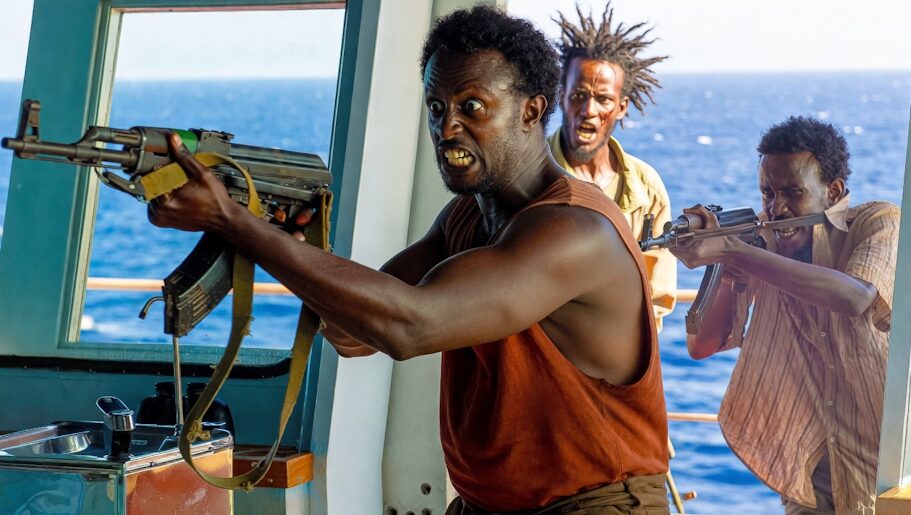
Most people remember Somali piracy from the Hollywood movie Captain Phillips — the dramatic 2009 hijacking of the Maersk Alabama that shocked the world.
By 2016, a massive international naval coalition had largely suppressed the threat.
The pirates went quiet. The world moved on. But they never truly disappeared.
And in 2026, Somali piracy is back — more organized, more aggressive, and more dangerous than before.
As of mid-May 2026, analysts confirm that Somali piracy is an active operational threat to commercial shipping in the Western Indian Ocean and southern Gulf of Aden.
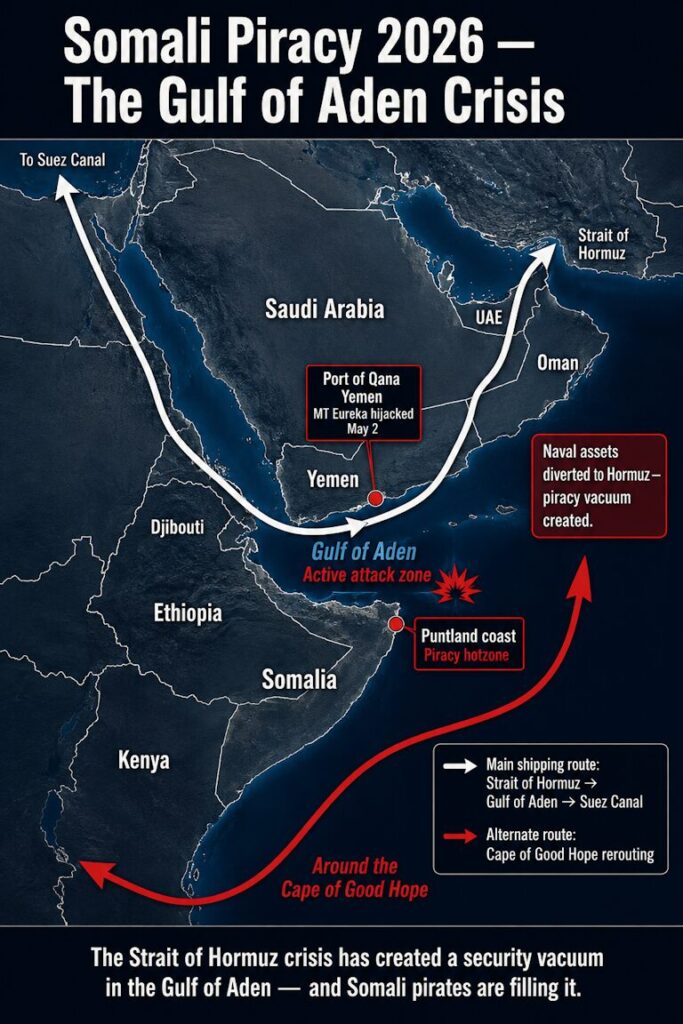
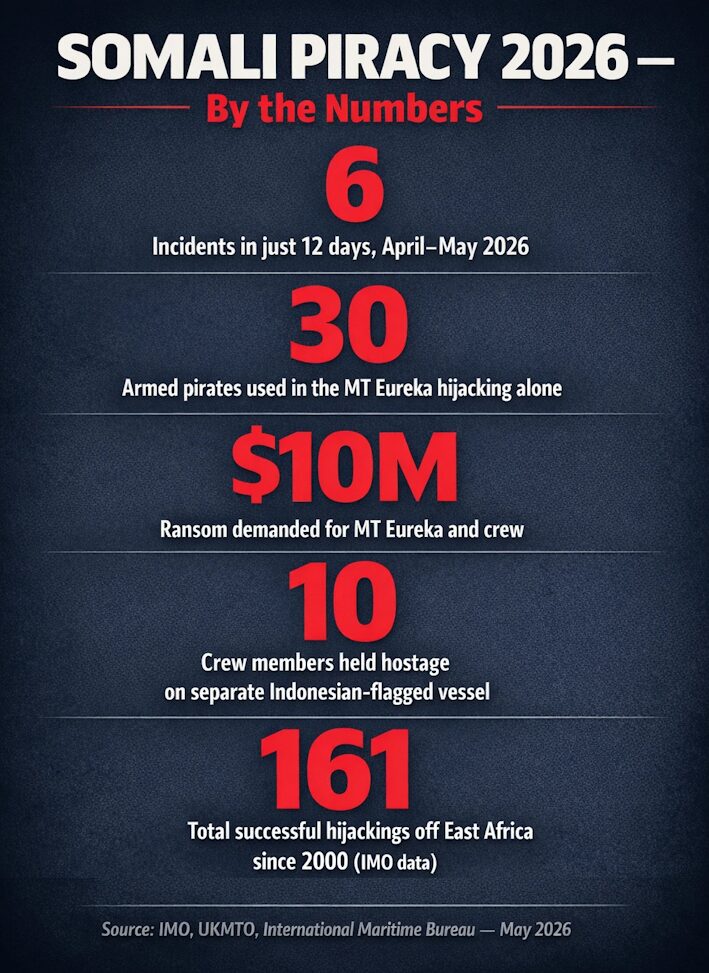
Six incidents in twelve days. Four hijackings in quick succession off the Puntland coast of Somalia in late April alone.
The most dramatic case is the MT Eureka — a Togo-flagged oil tanker hijacked on May 2 in the Gulf of Aden near Yemen’s port of Qana, now being steered toward the Somali coast with its crew held hostage.
Pirates are demanding $10 million ransom for the ship and crew.
A separate Indonesian-flagged vessel is also being held, with ten Pakistani crew members in captivity.
Video of those hostages circulating on social media has added a human face to a crisis the mainstream media is largely ignoring.
This is not 2012. The pirates never fully went away. They just waited for the right moment — and that moment is now.
New tactics, new threat — this is not your father’s piracy
What makes Somali piracy 2026 genuinely alarming is not just the scale of attacks — it is the tactical evolution.
Historically, Somali pirate groups operated in small teams of eight to twelve men.
The MT Eureka was seized by approximately 30 armed pirates — a group nearly three times the historical average.
Security analyst Christopher Hockey told The Sun that the larger pirate groups and cross-Gulf operations mark a clear tactical evolution.
The geographic reach has also expanded dangerously: the MT Eureka was taken on the Yemeni side of the Gulf of Aden — territory where Somali pirates have rarely operated before.
Analysts tracking the data note that a 500 nautical mile mothership-supported approach east of Mogadishu suggests the pirates have materially shifted their operational range — meaning they can now strike farther, faster, and with more force.
Beyond cargo ships, luxury cruise vessels are now being targeted and boarded.
The International Maritime Bureau has documented the reactivation of dormant maritime criminal networks — not random opportunists, but organized groups with training, equipment, and coordination.
The Puntland Maritime Police Force is attempting to patrol the Gulf of Aden, but their capacity is simply no match for 30-man armed assault teams.
The current resurgence unfolds within a more fragmented maritime security environment, where patrol coverage is less continuous and response times are longer than during the previous counter-piracy decade.
The pirates know exactly what they are doing.
And they know exactly what is not stopping them.
The Hormuz connection — America’s naval bandwidth is being stretched
Here is the strategic reality behind Somali piracy 2026 that almost nobody in the mainstream media is connecting publicly.
The Gulf of Aden sits directly between the Strait of Hormuz to the east and the Suez Canal to the northwest — one of the most critical maritime corridors on earth.
Analysts are now directly attributing the piracy resurgence to naval resources being redirected toward Houthi attacks in the Red Sea and, more recently, toward the ongoing US-Iran war and the Strait of Hormuz crisis.
The same coalition assets that once suppressed Somali piracy — the US-led CTF-151, the EU’s Operation Atalanta, and NATO’s Operation Ocean Shield, supported at peak by 25 to 30 warships from the US, UK, France, Russia, China, India, Japan, and South Korea — are now focused elsewhere.
CENTCOM (@CENTCOM) is conducting active self-defense strikes against Iranian mine-laying boats and missile sites in southern Iran.
Naval bandwidth is finite.
And with the Hormuz closure forcing more commercial shipping to reroute via the Cape of Good Hope and past Somalia, traffic through the most pirate-prone waters in the world has actually increased — while the naval protection has dramatically decreased.
That is not a coincidence. That is a security vacuum. And criminal networks always fill security vacuums.
The pirates are not creating this opportunity. Washington’s distraction is creating it for them.
Al-Shabaab, terror finance, and the America First stakes
Somali piracy 2026 is not just a maritime insurance problem.
It is a direct national security concern with deep links to Islamic terrorism — and that is where every American should pay close attention.
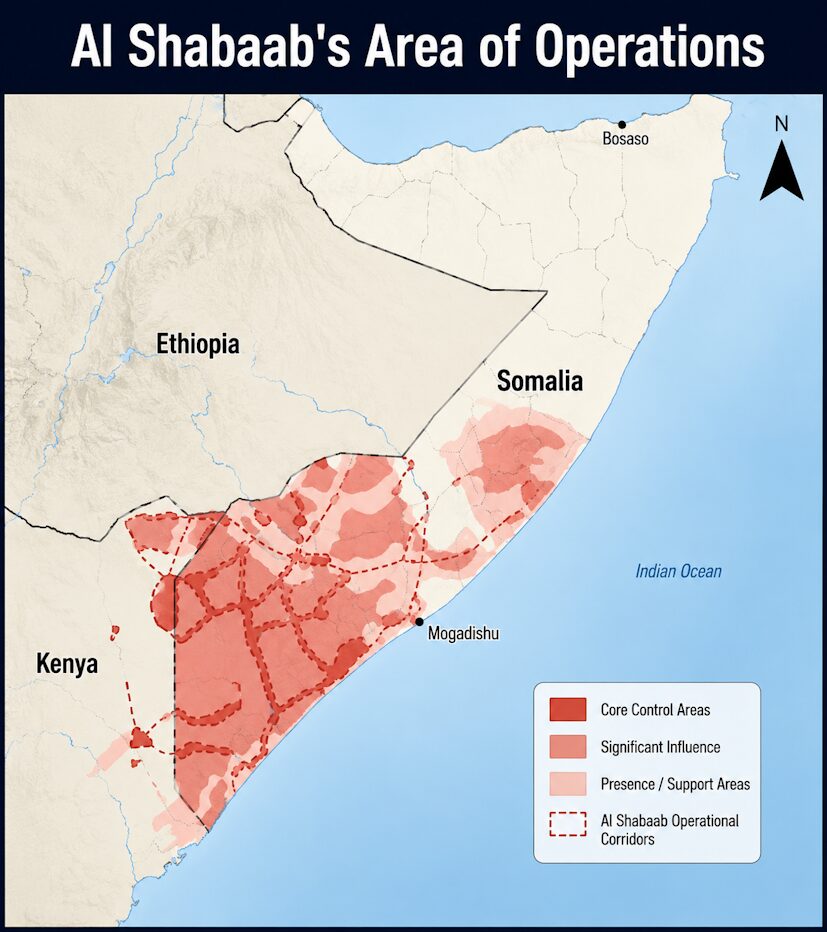
Historically, Somali piracy has been financially linked to Al-Shabaab — the Al-Qaeda affiliated jihadist group that controls large parts of southern Somalia and has carried out mass casualty attacks across East Africa, including the 2013 Westgate shopping mall massacre in Nairobi that killed 67 people.
Ransom money does not stay in pirates’ pockets. It flows into weapons purchases, recruiting operations, and regional terror networks.
The UKMTO has warned that the threat of piracy remains extremely high along the Somali coastline and in the Somalia Basin, with northern Somalia — particularly Puntland waters and the Gulf of Aden — identified as the highest risk zones.
The Gulf of Aden carries a significant share of global maritime trade.
With Hormuz disrupted, that share is growing every day as more vessels reroute through those waters.
Russia and China both have naval interests in the region — and neither is rushing to fill the security gap on behalf of Western shipping.
From an America First perspective, this is not a problem for the African Union to manage alone.
It is a direct threat to global energy supply, allied commercial shipping, and the funding pipelines of Islamic terror networks.
John MacArthur (@JohnMacArthur) reminds us that evil does not pause while good men are distracted — it advances precisely in those moments.
That is what we are watching in the Gulf of Aden right now.
The US cannot fight a war in the Persian Gulf, manage a Haiti collapse, and ignore a piracy resurgence in the Indian Ocean simultaneously — not without consequences.
Prioritization is strategy. And right now, the pirates are winning by default.