
This post is also available in:
 Português
  Español
  Français
  Deutsch
  Italiano
  Русский
  Nederlands
  日本語
日本語  Polski

Haiti gang crisis: a nation collapsing 700 miles from Florida
The Haiti gang crisis is no longer a humanitarian emergency on the margins of global attention. It is a full state collapse in slow motion — happening 700 miles from the coast of Florida.
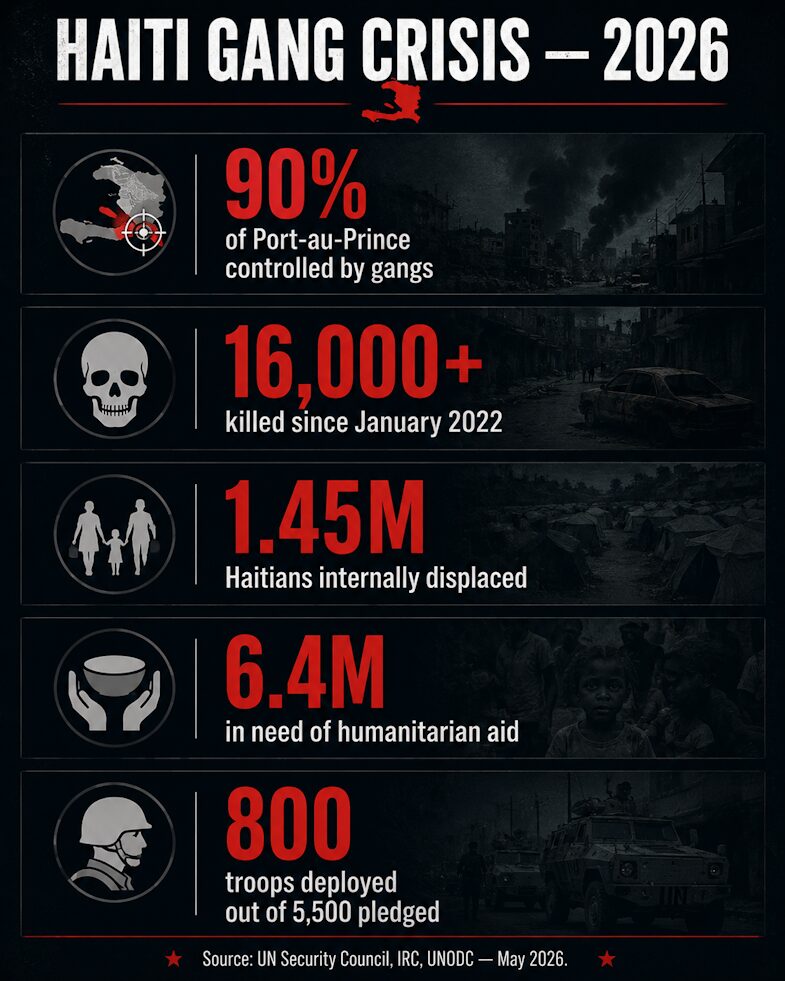
Armed gangs now control an estimated 90% of Port-au-Prince, Haiti’s capital city, employing murder, kidnapping, and systematic sexual violence as deliberate weapons of terror.
The Viv Ansanm coalition — born from Port-au-Prince’s most powerful gangs — has carried out large-scale attacks on police stations, prisons, and critical infrastructure.
The UN has documented the use of collective rape and child recruitment.
Over 1.45 million Haitians are internally displaced. Nearly 6.4 million — more than half the entire population — are in need of humanitarian assistance.
Haiti’s own foreign minister told the United Nations that gang violence poses “an existential threat” — threatening “the very survival of our state.”
The International Rescue Committee (@RESCUEorg) warns plainly that conditions for millions of Haitians are likely to worsen in 2026 unless urgent action is taken.
That is not a prediction. That is an organization watching a country die in real time.
Since January 2022, more than 16,000 people have been killed. The gangs are not retreating. They are expanding.
The Gang Suppression Force — too little, too late?
The international community’s answer to the Haiti gang crisis is the newly formed Gang Suppression Force — the GSF — which replaced the failed Kenyan-led Multinational Security Support mission in late 2025.
The transition represented a significant shift in mandate: unlike its predecessor, the GSF is authorized to conduct counter-gang operations independently, not just support and train Haitian police.
Jack Christofides, the GSF’s special representative, told the UN Security Council on April 23 that the mission’s operating plan has been finalized and that troop pledges have actually exceeded the 5,500-person ceiling.
That sounds promising. But the reality on the ground tells a different story.
Only about 800 troops have deployed so far — contingents from Chad, Guatemala, and El Salvador — with the force projected to reach full strength by October 2026.
Major General Erdenebat Batsuuri, a Mongolian military officer with over three decades of UN peacekeeping experience, arrived in Port-au-Prince on May 14 to assume command.
Haiti’s gangs are not waiting for October. On March 29 alone, at least 30 people were killed in a single overnight attack by the Gran Grif gang in Petite-Rivière de l’Artibonite.
Pledges are one thing. Boots on the ground are another.
The US bandwidth problem — Iran is consuming Washington
Here is the geopolitical reality nobody in the mainstream media wants to say plainly.
The Haiti gang crisis is getting worse in part because Washington’s attention, military assets, and diplomatic bandwidth are completely consumed by the Iran war and the Strait of Hormuz crisis.
Secretary of State Marco Rubio (@MarcoRubio) and the White House are absorbed by Iran and Hormuz negotiations, NATO meetings on Russia, and China trade tensions.
The US has contributed $110 million in humanitarian aid to Haiti and over $90 million in security support over 18 months — including armored vehicles, training, and 16 US military advisors helping grow a counter-gang unit to 110 officers.
That is generous help, but it is still not enough.
With the Hormuz closure cutting 14 million barrels of oil per day from global supply and driving inflation, Congress and the White House have shifted focus entirely to energy and defense.
Haiti’s trust fund sits at $101 million — a fraction of what the crisis demands.
The US Embassy in Port-au-Prince has already warned publicly of reported bribery attempts aimed at destabilizing Haiti’s fragile transitional government.
Washington sees the problem. Washington just doesn’t have the bandwidth to fix it right now. And every week of delay costs Haitian lives.
Caribbean security and America First — why Haiti matters to us
From an America First perspective, the Haiti gang crisis is not a distant charity case.
It is a direct national security concern.
Intentional homicides in Haiti’s Artibonite and Centre departments increased by 210% between January and August 2025 compared to the same period in 2024.
Organized criminal networks with defined leadership, territorial ambitions, and diversified revenue streams from drug and weapons trafficking do not stay within borders.
They export violence, refugees, and narcotics — straight toward the United States.
Haiti sits between Cuba and the Dominican Republic, directly in the Caribbean drug trafficking corridor that feeds the American mainland.
A collapsed Haiti is a narco-state by default — a failed state that criminal organizations, and potentially hostile foreign powers, can exploit at will.
China and Cuba are watching.
The Bible warns in Proverbs 27:12: “A prudent person foresees danger and takes precautions.” A prudent nation does not wait until its neighbor’s house is fully consumed by fire before reaching for the water.
The flames from Haiti’s collapse — drugs, migrants, organized crime, and foreign exploitation — will reach American shores long before Washington finishes its war in the Middle East.
The Haiti gang crisis is not someone else’s problem. It is ours — whether we choose to own it or not.
Pray for Haiti.