
This post is also available in:
 Português
  Español
  Français
  Deutsch
  Italiano
  Русский
  Nederlands
  日本語
日本語  Polski
Peru election 2026: the fight for Peru’s soul
This article is inspired by a recent video interview conducted by journalist Karina Mariani for VOZ Media, in which she speaks with Alejandro Cavero, a congressman representing Avanza País.
Avanza País is a right-wing Peruvian party that stands for economic liberalism, conservative values, and the defense of Peru’s 1993 constitutional framework.
Avanza País is not formally affiliated with Keiko Fujimori’s Fuerza Popular party, but both movements share a firmly anti-communist, pro-market, pro-democracy orientation and have historically cooperated in Congress to block leftist advances.
That context matters for everything that follows.
Peru just held its first-round presidential election on April 12, 2026 — and what happened that day is still generating controversy.
For readers unfamiliar with how Peruvian elections work: when no candidate wins more than 50% of the vote, the top two finishers advance to a runoff, called a “segunda vuelta” or balotaje.
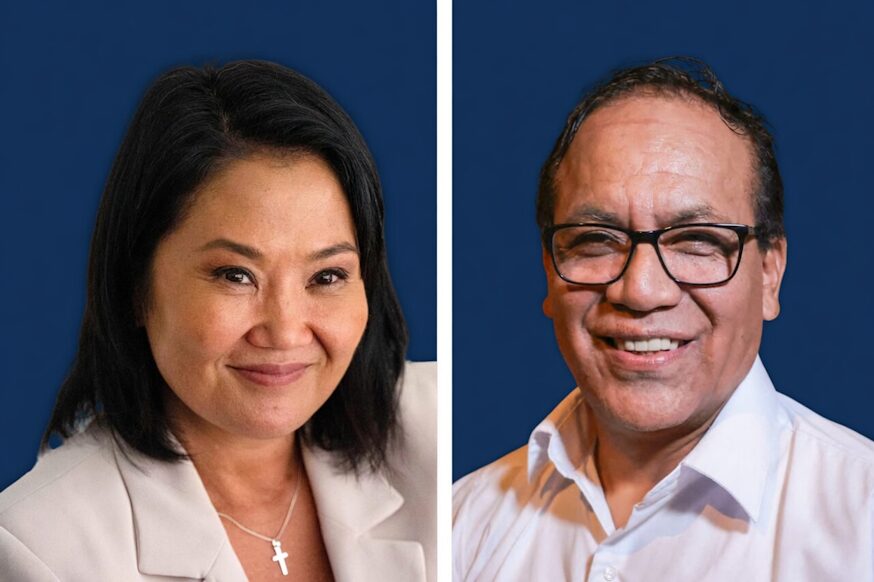
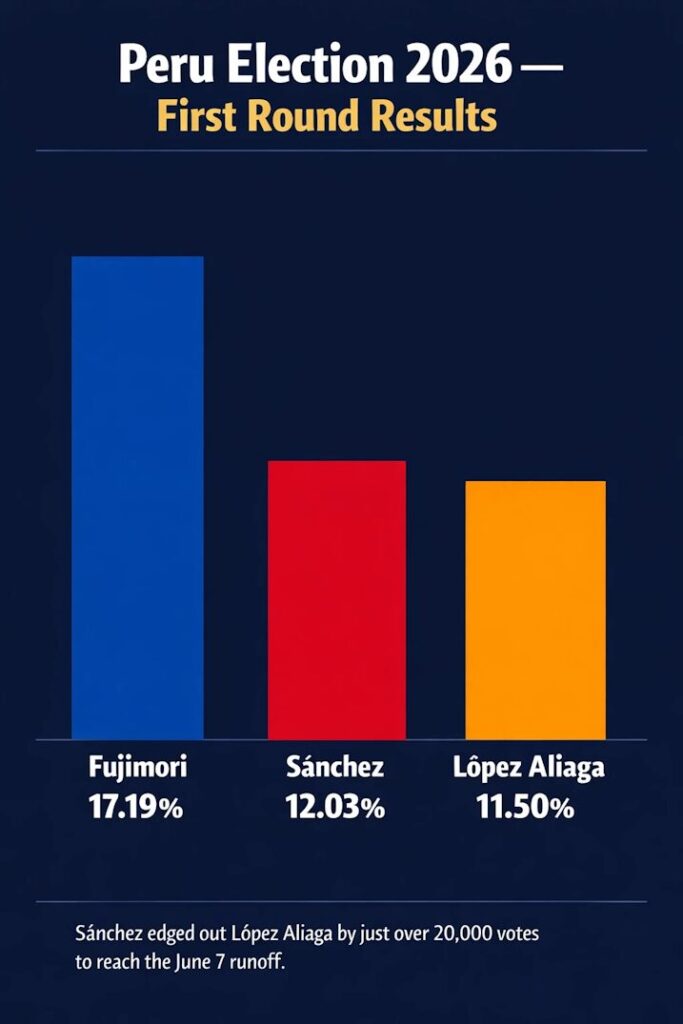
In this first round, featuring 35 candidates, Keiko Fujimori of Fuerza Popular finished first with 17.19% of the vote — reaching a presidential runoff for the fourth consecutive time — while Roberto Sánchez of Juntos por el Perú came in second with 12.03%.
Third place went to Rafael López Aliaga of Renovación Popular, who finished just over 20,000 votes behind Sánchez — an agonizingly thin margin that immediately triggered accusations of irregularities.
We covered López Aliaga’s complaints here at Chomcho.com.
The tight race for second place, combined with widespread logistical failures on election day, led to a postponement of official results by more than a month.
The runoff between Fujimori and Sánchez is now set for June 7, 2026. Whoever wins will be sworn in on July 28 as Peru’s next president.
Grave failures on election day — and a month of suspicious silence
Peru Election 2026 was also historic for another reason: it marked the return of a bicameral Congress — 130 deputies and 60 senators — for the first time in over three decades. But more on that shortly.
Congressman Cavero describes the logistical failures on April 12 as “grave.”
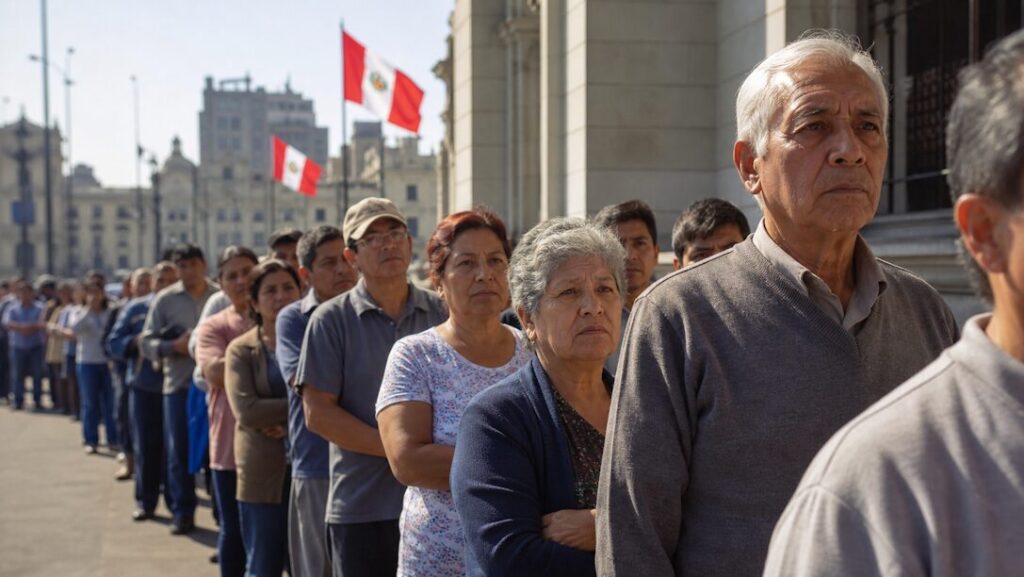
In Lima — Peru’s largest and most politically decisive city — many voting stations were not operational until around noon.
Cavero cites the University of Lima, one of the capital’s largest polling centers and where he personally voted, as a direct example of the disorder.
Long lines under the blazing sun caused many elderly and disabled citizens to abandon the line without casting their ballot.
This, Cavero argues, was not simple incompetence.
He believes the National Office of Electoral Processes, known as ONPE, allowed a deliberate suppression of the vote in areas where López Aliaga — whose strongest support is concentrated in Lima and the north of the country — stood to gain the most.
A month-long delay before official results were announced, he says, cast what he calls a “mantle of suspicion” over the entire process.
These are serious charges. And they matter precisely because the margin between second and third place was so razor-thin.
Who Is Roberto Sánchez — and why conservatives are alarmed
Understanding what is actually at stake in Peru Election 2026 requires understanding who Roberto Sánchez really is.
Congressman Cavero does not soften his assessment.
Sánchez is a self-described “castillista” — a political ally and defender of former president Pedro Castillo, who is currently imprisoned for attempting a coup d’état in December 2022.
Sánchez has pledged to pardon or free Castillo if elected.
His broader agenda follows what Cavero calls a “Bolivianization” strategy — a deliberate effort to model Peru after Bolivia, Venezuela, Cuba, and Nicaragua.
That means pushing for a constituent assembly to rewrite Peru’s constitution, specifically targeting its economic chapter to enable the nationalization of industries and the implementation of price controls.
Beyond ideology, Sánchez carries serious legal baggage: a public prosecutor has requested a five-year prison sentence against him for the alleged misappropriation of campaign funds.
He also served as a minister under Castillo’s government, where he faced multiple scandals involving improper hiring and administrative mismanagement — and then conveniently realigned himself with Castillo’s movement when it became electorally profitable.
Laura Loomer (@LauraLoomer) has said it plainly about figures like this: the radical left does not announce its intentions — it disguises them until it has the power to act on them.
Peru’s surprising institutional resilience
Many observers look at Peru from the outside and see nothing but chaos.
Nine presidents in ten years. Constant impeachments. Political crisis as a permanent condition.
However, Congressman Cavero offers a more nuanced and compelling picture.
Peru’s macroeconomic foundations have remained remarkably solid through all of it.
The country has maintained low inflation, a healthy economy, and investment-grade credit status — even while burning through eight heads of state in less than a decade.
Cavero credits three pillars for this resilience: a fiercely independent Central Bank that has resisted political interference from both left and right; a robust 1993 constitutional framework that established sound macroeconomic protections; and a private sector that has advanced in spite of the State, not because of it.
The frequent presidential removals — called “vacancias” — are not a sign of institutional failure.
They are, Cavero argues, a constitutional safety valve. They have prevented corrupt or authoritarian leaders from consolidating power before the damage becomes permanent.
As Charles Spurgeon once observed, a nation’s true strength is not measured in the absence of crisis — but in whether its foundations hold when the storm arrives.
Peru’s foundations have held. That is no small thing.
The June 7 runoff — why the free world should want Keiko to win
Together, the right-wing parties of Fujimori and López Aliaga command a majority in both the Senate and the lower house — which is why Congressman Cavero is emphatic: López Aliaga must now unite behind Keiko Fujimori and form a true “wall of containment” against Sánchez’s radical project.
The stakes of Peru Election 2026 go far beyond Lima.
This new bicameral Congress — with 60 senators and 130 deputies — takes effect in July 2026.
Under this restored two-chamber system, removing a sitting president requires a two-thirds majority vote in both chambers. That is a dramatically higher bar than before.
If Sánchez wins and attempts to consolidate power the way Castillo did in 2022, Congress will find it significantly harder — perhaps impossibly harder — to stop him in time.
The bicameral structure designed to bring stability could ironically become the shield that protects a leftist authoritarian from accountability.
This is not a theoretical risk.
This is exactly the playbook used in Venezuela, Bolivia, and Nicaragua.
For the United States and the free world, the outcome of this runoff has direct geopolitical consequences.
A Fujimori government means a market-oriented, constitutionally stable Peru that is a natural ally of Washington — important for trade, regional security, and containing Chinese and Cuban influence in South America.
A Sánchez government means another domino falling toward the Bolivarian axis — another country potentially opening its doors to Iranian influence, Chinese Belt-and-Road dependency, and the systematic dismantling of democratic checks.
America First means caring about what happens in Lima on June 7. We cannot afford another Venezuela in the Andes.
Pray for Peru.