
This post is also available in:
 Português
  Español
  Français
  Deutsch
  Italiano
  Русский
Summary
De la Espriella's definition of globalism was the sharpest of the week: "a concept in which the nation, sovereignty, identity, traditions and values are obstacles that must cede before a cultural and political uniformity decided in supranational circles. I don't share that doctrine, which I consider perverse and harmful."
Cooperation between nations, yes; globalist institutions above nations, no. The same week Colombia broke diplomatic relations with Iran.
Compare that with Gustavo Petro, who in 2022 asked the same hall whether cocaine, coal or oil is more poisonous, and who in 2025 told American soldiers on a New York street to disobey Trump.
Javier Milei called the UN a "useless organization whose only purpose is to sustain a caste of fatally arrogant parasites" and explained why Argentina left the WHO.
Keiko Fujimori declared criminal networks "terrorist groups" and asked the UN to respect each nation's limits. José Antonio Kast of Chile said the next decade can be "ours" for Latin America.
Four presidents, one philosophy, arrived at from four different wounds. Brazil and Mexico are still governed by the left; Brazil votes in October.
On September 22, two days before Colombia's speech, Trump told the UN General Assembly there is "no global government," no global taxes, and called on every member of the International Criminal Court to "resign from this rogue institution immediately."
Netanyahu, facing a walkout, called the departing delegates "moral cowards." Colombia stayed in its seat.
Scripture does not promote the nation-state, but its principles run against every project to rule all peoples from one center: Babel was the first, and Revelation describes the last.
Patriotism is not a sin. It is a virtue with an order: God first, then family, then country.
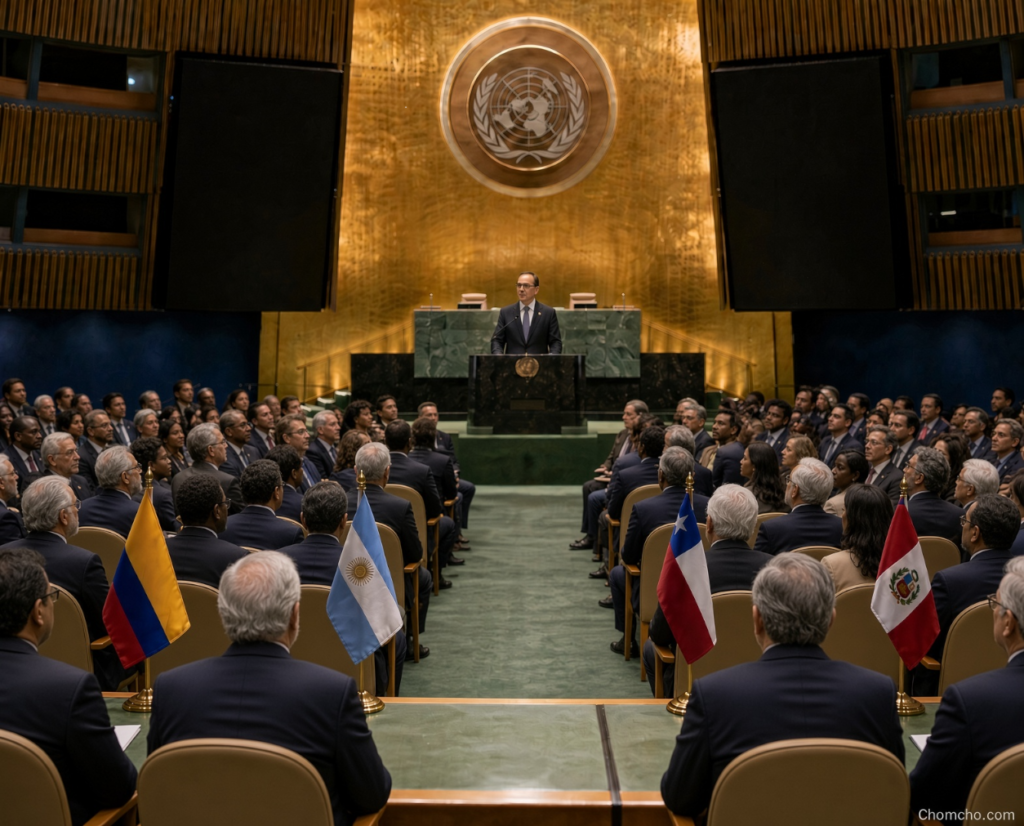
A hemisphere stands up: Colombia tells the UN that nations are not obstacles
On Thursday, September 24, Vice President José Manuel Restrepo climbed the podium of the 81st General Assembly and read a 14-page speech written by President Abelardo de la Espriella.
The president stayed in Bogotá to keep a campaign promise: four years without leaving Colombia. “I am keeping that promise,” the text said, and it reminded the hall that three days after his inauguration a 7.4 earthquake struck, and “my compatriots under the rubble could not wait.”
Forty-seven days into office, the speech announced the “Patria Milagro,” the miracle homeland of his campaign, which De la Espriella himself described in August as a Colombia rebuilt on “unity, work and love of country.”
The same week, and with no drama, the Foreign Ministry confirmed that Colombia broke diplomatic relations with Iran on September 19, citing Tehran’s ties to terrorist and narco-terrorist groups, its human-rights record, its blockade of the Strait of Hormuz and its obstruction of nuclear inspectors. Consular relations remain.
Between the UN speech and the break with Iran, the direction of Colombia’s new foreign policy is clear: Washington and Jerusalem, not Tehran and Caracas. On UN and globalism, Bogotá now also speaks the language of the hemisphere’s new presidents.
What De la Espriella means by globalism
De la Espriella wrote the best definition of globalism heard at this General Assembly.
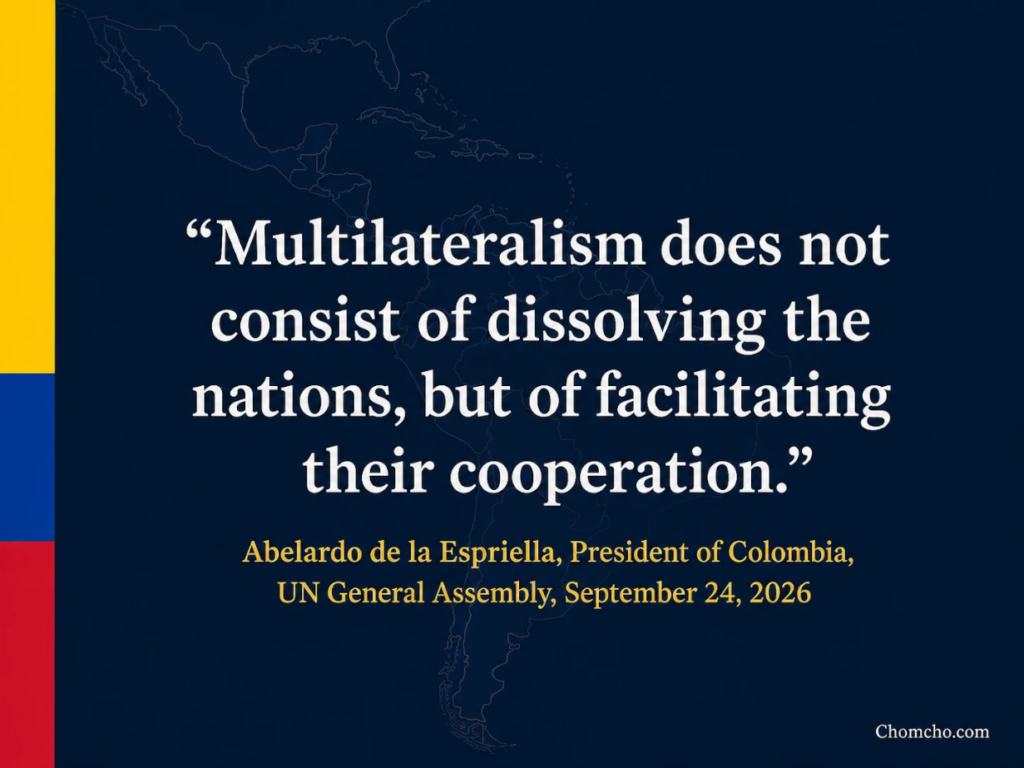
He described it as “a concept in which the nation, sovereignty, identity, traditions and values are obstacles that must cede before a cultural and political uniformity decided in supranational circles. I don’t share that doctrine, which I consider perverse and harmful.”
Then he separated the good from the bad: “Multilateralism does not consist of dissolving the nations, but of facilitating their cooperation. Loving the fatherland is not incompatible with respecting the rest.”
He asked whether the UN “is fulfilling those purposes with the effectiveness the modern world demands,” and he went after its double standard, saying that human rights cannot be “a flag raised against some and hidden against others.”
Our broad reading of that line: the UN decides by majority vote, and the Muslim bloc and China have the votes, so their abuses are hidden while Israel and the West are condemned.
He also proposed something concrete: an international legal definition of terrorism, because groups that murder, kidnap and recruit minors “are terrorist groups. That is what we call them.”
The before picture: Petro at the same podium
Gustavo Petro never disappointed those who listen to UN speeches for a little drama.
In 2022, his first speech, he asked the world, “What is more poisonous for humanity, cocaine, coal or oil?” and answered that the war on drugs “has failed” while coal and oil “must be protected.” He defended coca as the sacred plant of the Incas.
Outside the UN he was more direct, defending the coca grower and calling for the drug war to end.
In 2025 he spoke at length, demanded a criminal process against Trump over U.S. strikes on boats in the Caribbean, “including the senior official who gave the order,” and then, on a New York street, told American soldiers to “disobey the orders of Trump.”
The State Department revoked his visa that night. Petro answered that he did not care: he is also a European citizen.
That was Colombia’s voice at the UN one year ago.
This year the voice belongs to a lawyer who wrote 14 pages about sovereignty and cooperation and never once raised his tone.
Milei: the UN as a “bureaucratic leviathan”
Javier Milei spoke on Wednesday, September 23, his third time at the podium, and he spoke bluntly.
The UN, he said, has broken the “sacred covenant” on which it was founded. It has become a “useless organization whose only purpose is to sustain a caste of fatally arrogant parasites masquerading as well-intentioned bureaucrats.”
He then added, that it has “built a bureaucratic leviathan devoted to deciding how the peoples of the world and their citizens should live.”
On the pandemic: “Where some allege a public health policy error, we see a global experiment in social control disguised as science.” That, he said, is why Argentina left the World Health Organization.
On the result: “a curious mixture of anarchy and tyranny, impotence in the face of those who break the most basic rules, such as bloodthirsty dictatorships and terrorist organizations, coupled with Orwellian control and impositions on liberal democracies that abide by the rules.”
Argentina, he said, is “unequivocally aligned” with the West, the United States and Israel, will not regulate artificial intelligence pre-emptively, and will keep pressing its claim to the Malvinas.
He finally quoted the economist Ludwig von Mises: “Good people do not think about controlling the lives of their fellow human beings.”
Fujimori and Kast: the crime front
Keiko Fujimori, 57 days in office, spoke on September 22 and said less about globalism and more about the enemy at home.
Latin America, she said, is in “a war” against transnational organized crime, and the criminal networks “are terrorist groups and must be confronted as what they are: enemies of the democratic state.”
She wants the armed forces backing the police, she defended the soldiers still on trial 34 years after defeating the Shining Path, and she asked the UN to “respect the limits” of each nation.
Peru has joined Trump’s Shield of the Americas and the Santiago Commitment, a five-country pact against organized crime signed in May by Argentina, Bolivia, Chile, Ecuador and Peru.
José Antonio Kast of Chile, the same day, said the next decade can be “ours” for Latin America.
He described a country “broken” by socialist governments, reported mass deportations of foreigners illegally in Chile, and put border security, police and organized crime at the center of his speech.
Neither speech was about globalism by name, but both were about the same thing: the state answering to its own citizens before it answers to anyone else.
A hemisphere that thinks alike
Four presidents, four speeches, one philosophy: crime treated as terrorism, sovereignty over unelected bureaucracy, friendship with the United States and Israel, and no global regulation of artificial intelligence.
Each of them arrived at it from his or her own country’s wounds: Argentina’s inflation, Peru’s extortion, Chile’s borders and Colombia’s guerrillas.
In 2017 Trump told the same hall, “I will always put America first, just like you, as the leaders of your countries, will always, and should always, put your countries first.”
Nine years later, the hall heard that idea in Spanish, four times, from four capitals.
The map is not, however, complete.
The two largest countries in the region, Brazil and Mexico, are still governed by the left, and Lula came to New York framing his own trip as a sovereignty message ahead of a tight election.
Brazil votes in October 2026. If the left loses the presidency of Brazil, the region’s new majority will speak with one voice.
Netanyahu, Glenn Beck, and a video Google’s Gemini AI would not transcribe
Colombia’s speech ended and Benjamin Netanyahu walked to the same podium.
Dozens of delegations walked out before he spoke; Turkey’s Anadolu news agency counted roughly 70 countries absent or leaving, Brazil among them. Colombia stayed in its seat.
Netanyahu did not soften his message, and neither will we at Chomcho.
He called the departing delegates “moral cowards,” said the genocide accusation is “the biggest lie of the century,” and that attacking Iran “was one of the easiest decisions I’ve ever had to make.”
Glenn Beck saw in the walkout something older than politics: biblical prophecy unfolding in a UN hall.
“You don’t have to agree with the war … The world is choosing to side with people who are terrorists, murderers and rapists over the Jews,” he said in a YouTube video on the episode.
When we asked Google’s Gemini, which summarizes videos, to transcribe that line, it declined and gave no reason. So we transcribed it ourselves.
What Scripture says about nations and empires
The Bible does not explicitly promote the nation-state; it did not exist in its modern form. But its principles run against every project to rule all peoples from one center.
The first ever globalist project was Babel, in Genesis 11: one language, one tower, one name for all mankind, and God scattered it.
Paul told Athens that God “hath made of one blood all nations of men” and “hath determined the times before appointed, and the bounds of their habitation” (Acts 17:26, KJV). Nations are part of the design, not an obstacle to it.
The last globalist project will be the one Revelation describes: a beast given “power over all kindreds, and tongues, and nations” (Revelation 13:7, KJV), and kings who “have one mind, and shall give their power and strength unto the beast” (Revelation 17:13, KJV), before they gather against Jerusalem.
A Christian does not need to know the date to recognize the shape. When a president says that identity, tradition and faith must not cede to “uniformity decided in supranational circles,” he is not being backward. He is reading the same book.
Trump at the UN: “no global government”
Two days before Colombia, Trump gave the General Assembly clear instructions. The UN “must stop imposing the far left agenda of globalist bureaucrats who nobody ever elected.”
On the global carbon tax on shipping his administration blocked last year: “There is no global government, and while I’m president there will be no global taxes.”
The United States “totally rejects any attempt to construct a globalist scheme of control for the artificial intelligence.” He said his administration cut the UN budget 15 percent this year and eliminated more than 4,000 positions.
Then the International Criminal Court, “an out-of-control institution,” “an evil group of people”: “I call on all nations that are members of the ICC to officially resign from this rogue institution immediately.”
Marco Rubio had promised in July to dismantle the court “brick by brick.” Colombia is an ICC member. We hope that is one more decision waiting on De la Espriella’s desk.
What Trump has already done, and the order that matters
Trump does not argue with globalism; he walks out of it.
Out of the Paris climate agreement, out of the World Health Organization, out of the Human Rights Council, out of UNESCO, and now sanctions on ICC officials.
He also negotiates country by country, not bloc by bloc: the North American trade agreement is being reviewed on his terms, and most of the deals of the last year were signed capital by capital.
De la Espriella writes like a lawyer and Trump talks like a builder, but both separate good cooperation between nations from bad supranational institutions ruling above nations.
Patriotism is not a sin. It is a virtue, and it has an order: God first, then family, then country.
A man who keeps that order makes a good citizen, and a nation that keeps it makes a good neighbor. The UN and globalism have had their decade. This one belongs to the nations.