
This post is also available in:
 Português
  Español
  Français
  Deutsch
  Italiano
  Русский
  Nederlands
  日本語
日本語  Polski
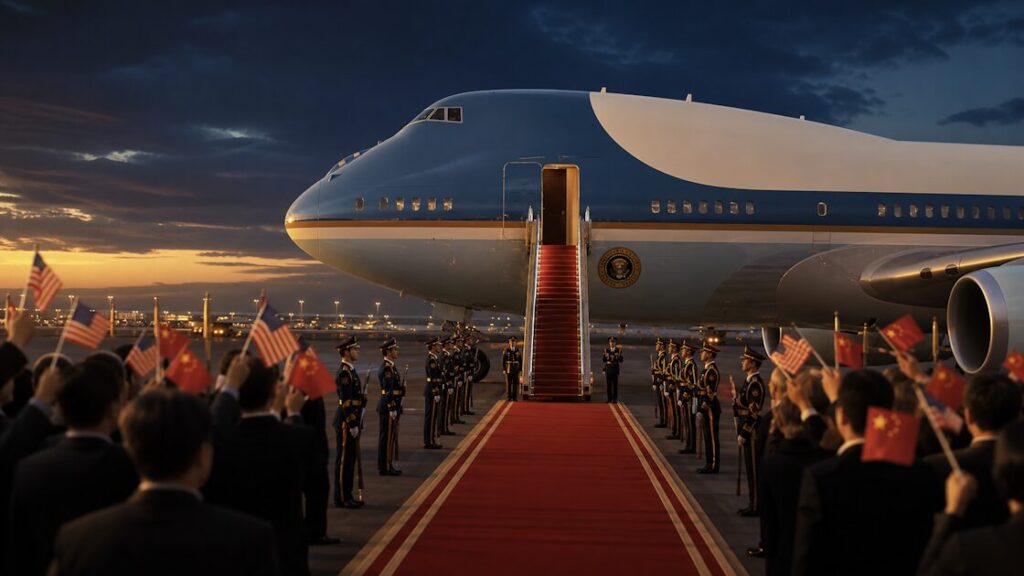
Trump Walks into the Dragon’s Lair
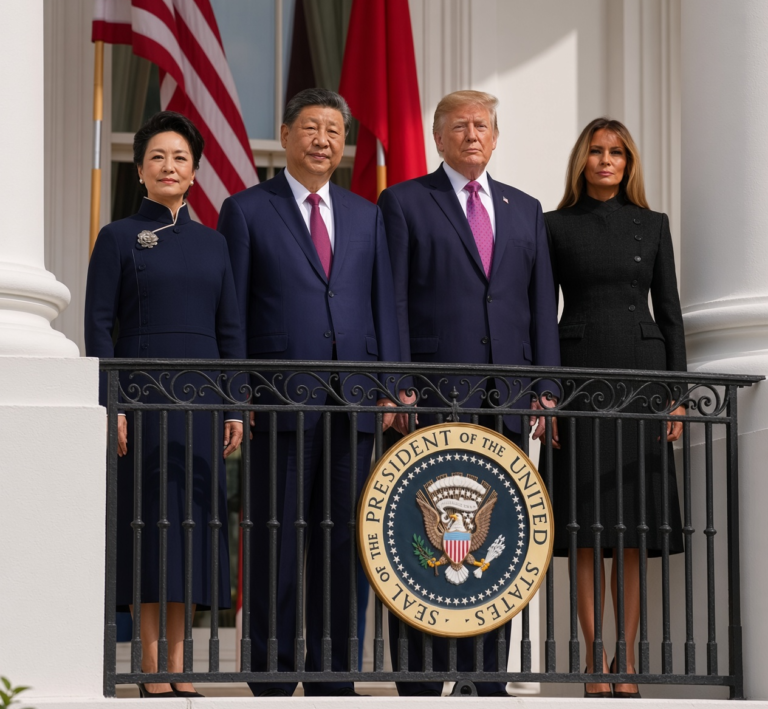
President Trump stepped off Air Force One in Beijing today, May 13, 2026 — the first U.S. presidential visit to China in nearly a decade.
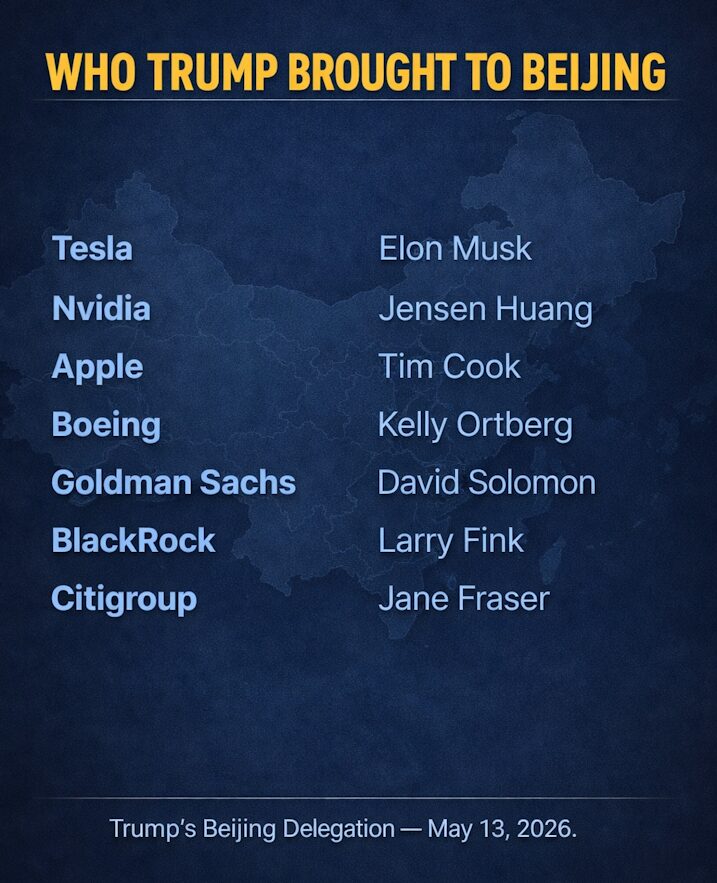
With him: Elon Musk (@elonmusk), Nvidia’s Jensen Huang, Apple’s Tim Cook, Boeing’s Kelly Ortberg, and over a dozen top CEOs from Wall Street and Silicon Valley.
Also aboard: Secretary of State Marco Rubio (@MarcoRubio) and Defense Secretary Pete Hegseth (@PeteHegseth). Eric Trump and Lara Trump joined in a personal capacity.
300 Chinese students waved American and Chinese flags on the tarmac. Gifts were presented. The pageantry was unmistakable.
Ceremony and Optics — A Show of Normalization
The welcome was full of choreographed Chinese precision: brass bands, honor guards, red carpets, and flag-waving crowds.
A state banquet and visits to the Temple of Heaven are on the schedule.
For Beijing, the spectacle signals stability and legitimacy on the world stage. For Washington, it says: America is back at the table — on its terms.
Both capitals needed this moment, even if for different reasons.
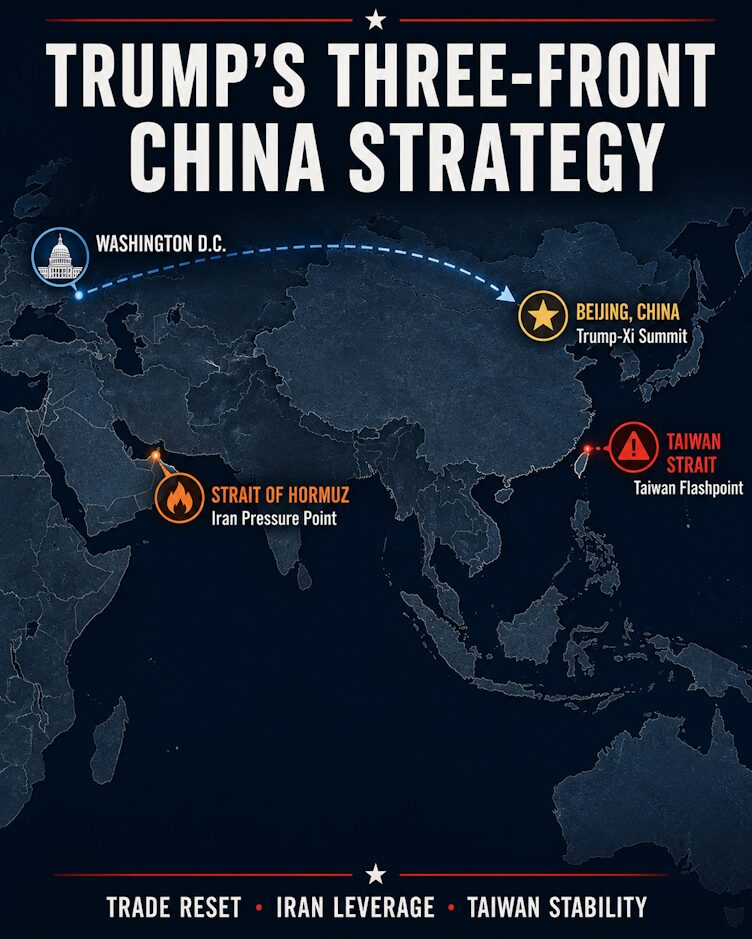
Goals on the Table — Trump’s and Xi’s
Trump walks in with three clear objectives. First, a trade reset: open Chinese markets to American companies — that’s why he brought the titans of U.S. industry.
Second, Iran pressure: with the Strait of Hormuz still a global flashpoint, Trump needs Xi to lean on Tehran. China is the world’s largest buyer of Iranian oil — that leverage is real, and Trump is calling it in directly.
Third, Taiwan stability: quiet but firm signaling while the Middle East burns. Beijing considers Taiwan a core internal interest and will push hard for limits on U.S. arms sales — a $14,000 million package approved by Congress is still awaiting Trump’s final signature.
Trump himself told reporters this week, “He’ll bring up Taiwan, I think, more than I will” — suggesting Xi may actually be the one pressing the issue, hoping to use Iran as leverage to extract concessions from Washington on Taipei. America must not trade Taiwan’s security for a trade deal.
About Xi’s goals in this meeting, they also mirror Trump’s but cut the other way. Beijing wants AI export controls eased, rare earth leverage preserved, and the current trade truce extended.
Conservative economist Oren Cass (@orencass) put it sharply: “Trump sees the problem with China as simply a bad deal. And what’s the remedy for a bad deal? Why, a better deal, of course.”
That framing is exactly right.
The Rubio Signal — China Blinked First
China sanctioned Rubio twice as a senator for defending Uyghurs and Hong Kong.
Beijing quietly changed the Chinese-character transliteration of his surname to issue him a visa without officially admitting it lifted the ban.
That tells you everything about how much China wanted this summit to happen.
When America walks in with Musk, Rubio, Hegseth, and a trillion-dollar business delegation, the world takes notice.
Strength wins at the negotiating table.
Response to @nicksortor [Replying to: https://x.com/nicksortor/status/2054535710225334750?s=20]