
This post is also available in:
 Português
  Español
  Français
  Deutsch
  Italiano
  Русский
The secret agreement and the real Lebanon sovereignty issue
On June 28, 2026, Israeli Channel 12 reported the existence of a classified security annex to the Israel-Lebanon framework agreement signed the previous week in Washington.
Daily Beirut and Palestinian news agency Sada News independently confirmed the details.
The annex was kept secret at Lebanon’s own request.
That single fact is the key to understanding everything that follows.
Lebanon did not ask for secrecy because it was ashamed of negotiating with Israel. It asked for secrecy because it feared what Hezbollah and Iran would do with the information.
The annex itself contains provisions Israel considers essential: the Israeli army retains full freedom to act against threats within the security zone in southern Lebanon.
There will be no automatic Israeli withdrawal. Any redeployment will be based on field conditions, not fixed timetables.
Only two small trial withdrawal zones have been announced, with no immediate expansion planned.
Israel’s Chief of Staff General Eyal Zamir called the agreement “historic and important” and stated: “We will adhere to the agreement and work to ensure its success. The test now is one of action from both parties.”
Lebanon negotiated this agreement because it wants peace.
It kept it secret because it knows the real enemy of Lebanese sovereignty is not Israel.
Who really threatens Lebanese sovereignty?
The mainstream media frames this conflict simply: Israel occupies Lebanese soil, therefore Israel threatens Lebanese sovereignty.
The facts are more complicated.
Israel entered Lebanon on March 2, 2026, after Hezbollah launched rockets at Israeli territory in support of Iran.
Israel did not initiate that conflict.
It responded to an attack launched by a foreign-funded militia operating on Lebanese soil without the Lebanese government’s authorization.
That is self-defense, not aggression.
The real, decades-long threat to the Lebanon sovereignty issue comes from within.
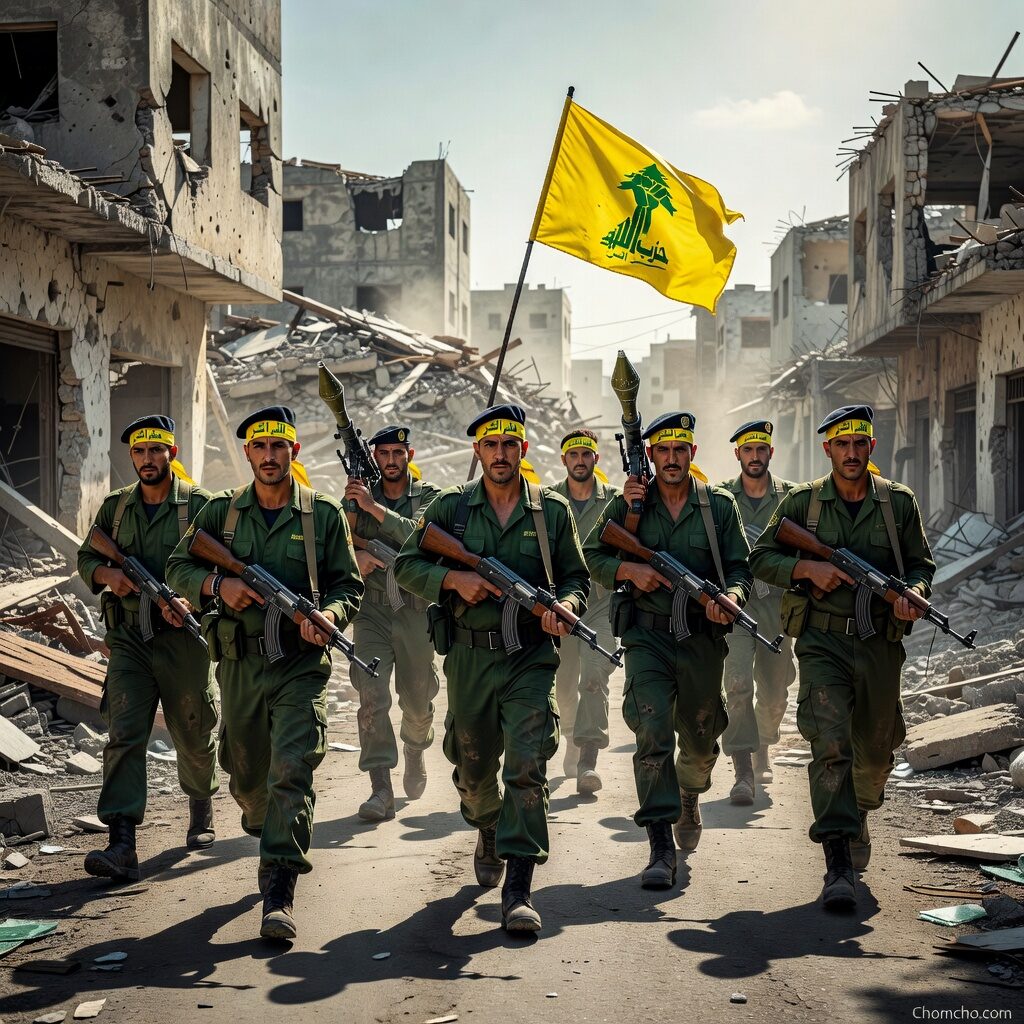
Hezbollah, funded, trained, and directed by Iran, has operated as a state within a state inside Lebanon for forty years. It runs its own military, its own intelligence services, its own courts, its own schools, its own hospitals, and its own financial system.
Dr. Lina Khatib of Chatham House, writing for the Gulf International Forum in June 2026, stated it plainly: “As long as the Islamic Republic exists, it will attempt to transform Lebanon into an Iranian vassal.”
She added that Iran cannot leave Lebanon because Hezbollah is central to the Islamic Republic’s own survival as a regime.
This is not a proxy relationship. It is colonial control.
Hezbollah as Lebanon’s deep state — the documented evidence
This is not opinion. It is documented across multiple authoritative sources.
Hezbollah has systematically infiltrated Lebanon’s government, security services, parliament, financial institutions, and judiciary for decades.
The position of director-general of General Security, traditionally held by a Maronite Christian by convention, was handed to a Hezbollah-aligned Shia official after intense lobbying by the group.
Since July 2011, Lebanon’s General Security directorate has operated under de facto Hezbollah oversight.
In May 2026, the U.S. Treasury Department sanctioned two senior Lebanese security officials, a brigadier general heading the national security department and a military intelligence officer, specifically for acting to preserve Hezbollah’s influence over Lebanese state institutions.
Four Hezbollah members of parliament were also sanctioned simultaneously.
Lebanon’s own Foreign Minister Youssef Rajji made the accusation publicly: Hezbollah used the conflict with Israel as a pretext to maintain its weapons, with its true goal being renewed control over government institutions.
A UPI analysis from December 2025 described Lebanon as governed by “mini deep states,” with Hezbollah operating a shadow parallel economy alongside the official Lebanese state.
The numbers are just as telling. A January 2026 poll found that 73% of Lebanese support disarming Hezbollah.
Even within the Shia community of southern Lebanon, residents and public figures from Tyre and Nabatieh publicly called for their cities to be declared free of Hezbollah weapons, under the exclusive protection of the Lebanese state.
This is not the profile of a legitimate resistance movement defending its people.
This is an occupying force wearing a Lebanese mask.
Iran tries to fold Lebanon into its own negotiations
The clearest proof that Iran treats Lebanon as a colony is what Tehran is now demanding at the negotiating table.
Iran does not want Lebanon treated as a sovereign state in its own right.
It is insisting that Hezbollah, and by extension Lebanon, remain part of Iran’s broader negotiations with Washington.
Tehran wants a veto over any peace agreement between Lebanon and Israel.
As Dr. Khatib warns: if Washington allows Tehran to fold Lebanon into the U.S.-Iran deal, any resulting agreement would legitimize Iranian control over Lebanon while leaving Hezbollah’s weapons intact.
That is not peace. That is Iran repackaging its occupation of Lebanon in diplomatic language.
We covered this dynamic in our Iran deal crisis article.
Iran claimed Israel violated the MoU by operating in Lebanon, even though Israel never signed the memorandum.
Iran used Lebanon as a pretext to resume hostilities. It is now using Lebanon as diplomatic leverage in Switzerland.
Iran cannot be trusted in negotiations. The violations of the MoU, signed just days before new provocations began, proved that again.
Iran only pauses when it is under maximum pressure. It advances the moment that pressure eases.
What Lebanon’s own government actually wants
Here is what is almost never reported.
Lebanon’s government is not protecting Hezbollah. It is fighting it.
President Joseph Aoun proposed direct peace talks with Israel, the first in decades. This was not a small gesture.
Aoun is Lebanon’s commander-in-chief and a former military man who knows exactly what he is doing.
By proposing direct talks, he is asserting that Lebanon is a sovereign state capable of making its own decisions, without asking Tehran’s permission.
Trump welcomed the proposal warmly. Hezbollah condemned it immediately.
Prime Minister Nawaf Salam, a former Lebanese ambassador to the United Nations, demanded the state’s exclusive monopoly over all weapons in Lebanon.
His message could not be clearer: there can only be one armed force in this country, and it must answer to the Lebanese state. Not to Iran.
Not to a militia that votes in parliament in the morning and fires rockets at Israel in the afternoon. Salam called the situation “the most severe crisis since Lebanon’s establishment.”
The Lebanese army declared “genuine, effective” control south of the Litani River in January 2026.
Lebanon’s Foreign Minister expelled Iran’s ambassador and declared him persona non grata. Iran refused to leave.
Hezbollah’s response to Lebanon’s peace negotiations was to call them “a national and strategic sin.”
Hezbollah’s affiliated newspaper called President Aoun and Prime Minister Salam “the occupation government in Lebanon.”
Hezbollah Secretary General Na’im Qassem threatened that his organization would confront anyone who tried to disarm it, without the need for consultations, “operating as ghosts” from wherever required.
That is not a resistance movement defending Lebanon.
That is a foreign proxy organization threatening Lebanon’s own elected government for daring to pursue peace.
Lebanon’s stability is America’s long-term interest
While much of the world focuses on the Strait of Hormuz and oil prices, the Lebanese people are fighting for something far more fundamental: their survival as a sovereign nation.
That matters to America.
A stable, sovereign Lebanon, free of Hezbollah’s armed presence, is one of the most important long-term strategic goals the United States could pursue in the Middle East.
It would sever Iran’s land and sea corridor to the Mediterranean.
It would eliminate the most capable Iranian proxy army on earth.
It would open the door to a Lebanon-Israel peace treaty that would be the first between Israel and an Arab state since Jordan in 1994.
Trump should not push Israel to withdraw from southern Lebanon prematurely.
The world is pressuring Washington over oil prices and the Strait of Hormuz. That pressure is real and understandable. But it must not become a reason to hand Hezbollah a lifeline.
Iran only understands military pressure.
Every concession made to Tehran without maximum pressure has been exploited. Every pause in military operations has been used by Hezbollah to rearm, regroup, and resume.
This pattern has repeated itself since 2006.
The near-term path is difficult. But the long-term logic is clear.
The total dismantling of Hezbollah will make Iran fundamentally weaker across the entire region.
It will force Tehran to recalculate its strategy in Iraq, Syria, Yemen, and Gaza.
It will remove Iran’s most effective tool for threatening Israel and destabilizing American allies. And it will put maximum pressure on Tehran to accept the one demand that matters most: the permanent end of its nuclear weapons program.
Trump should still pursue peace negotiations with Iran. But with an iron fist, not an open hand.
Peace with Iran requires military credibility, not diplomatic concessions to a regime that funds terrorism and violates every agreement it signs.
Iran speaks the language of power. America must speak it fluently.
Lebanon’s freedom from Hezbollah is not just a humanitarian goal. It is a strategic American interest.
And the secret annex to the Israel-Lebanon agreement, the one Lebanon asked to hide from Iran, tells you exactly which side of that fight Lebanon is on.
Lebanon has made its choice on the Lebanon sovereignty issue. America should back it.